
My father’s final resting place was on a grassy knoll overlooking the Los Angeles skyline, 7,000 miles from his childhood home.
Since he immigrated to California in the 1970s, he’d only returned twice to Xingang, a rural township in southern Taiwan, flying over eleven hours across the Pacific Ocean each way. These trips were also separated almost a decade apart. Once, for his mother’s funeral service before I was born. The last time, he brought my mother; me, nine-years-old; and my little sister, still a toddler, to visit his hometown. As a young girl, I didn’t have deep recollections of or appreciation for my father’s childhood, upbringing, and life.
Three years after his death from brain cancer, I made a journey to see my father’s surviving side of the family and his childhood home. I was now in my early thirties. I was a mother; my own daughter was around the same age as my sister was during our last family trip to Taiwan.
This time, though, I traveled alone. The seat I’d reserved was facing in the opposite direction of travel. I felt like I was literally falling into the past as I looked out the window. The Taiwan High Speed Rail reached 300 kilometers per hour, and the trees and foliage outside blurred. Perhaps, from the speed of the train carriage. Perhaps, from the tears that stung my eyes as I thought about my father and all the stories of his past that were clouded, and stolen, by his neurologic illness.
The first place I stopped by after arriving at the Chiayi train station to meet my aunt, uncle, and eldest cousin was a memorial hall, which housed the exhumed bones of my father’s parents, the grandparents I’d never met. The white walls gleamed like a shimmering pearl as we drove towards it. I wondered if my dad would’ve wanted to be buried with them, if he never left Taiwan, if he didn’t have his American daughters, who couldn’t even read the characters of their ancestors’ names on the memorial plaque. Before leaving, we arranged specialty snacks and sweet treats—crackers and banana-flavored Xingang soft candy—as offerings for the afterlife.
My aunt hugged me. She told me that, around the week when my dad died, she happened to dream about him. So, she had a feeling about his passing, even before my mother notified his family in Taiwan. I shivered in the sunshine.
My relatives next took me to a bustling street that led to the famed Fengtian Temple. It was undergoing renovations, so the true grandeur was obscured by construction scaffolding. The afternoon sun shone, bright and stark, on jolly-colored lanterns and a labyrinth of food stalls, peddling every kind of Taiwanese delicacy and dessert I could’ve imagined: bubble teas, oyster pancakes, stinky tofu, a specialty goose meat noodle soup for which the wait spanned over an hour.
Nearby was historic Daxing Road, the “rear street” behind Fengtian Temple, which was lined with traditional architecture, restored and refurbished. Another of my uncles, my dad’s youngest brother, still lived in their family’s original home on Daxing Road. The façade was a pharmacy selling traditional medicines, supplements, and herbs. The house was built according to a common style of its time: long—spanning the entire length of one block—and narrow—the width of one room, staccato-ed with open-air courtyards that provided natural light and places for clothes to be hung outside to dry, for elders to gather over tea, for kids to run and play. When my father and his eight siblings were children, they lived in the back of the complex. I carefully stepped over the raised stone threshold that separated each section of the house. My dad shared a bedroom with one of his brothers, stretching a bedsheet across the room from the ceiling as a makeshift curtain for privacy. Now, the rooms were in disarray, the roofs showing rust, its wooden structural elements warped with weather and time.
“You might want to see this,” my uncle said, angling his cell phone screen towards me. I saw a grainy photograph, its colors so faded as to render the image almost grayscale. The photo recently resurfaced because a gallery owner and amateur archivist, who lived across the street from my uncle, published a series of memorabilia about Daxing Road. I immediately snapped a picture of the image, a photo of a photo. Who knew where the original image was?
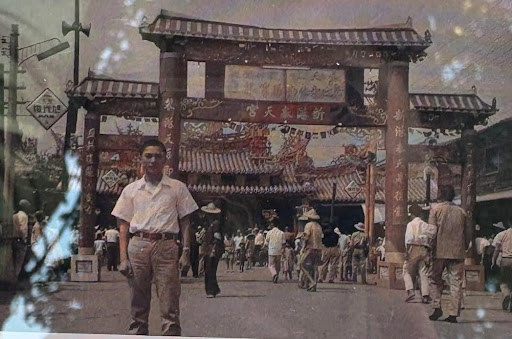
“Your father.” A young man, his crisp white shirt tucked into his belted pants. I could immediately see, in my mind, my dad’s preferred work outfit when he still operated his business. It was funny how little had changed despite all the time that passed. He stood alone, in the foreground of Fengtian Temple, which had a magnificent appearance back then. I myself had taken a selfie with my cousin there just hours prior. I was just standing where my dad had stood, when he was only twenty-one-years-old. The caption read: “老四,在美國”—”Fourth Brother, in America.” The rest of the paragraph listed the residences of his siblings. My dad was the only one who moved and started a new life in California, so far from his family and his home. From what I knew about his move and his life before I was born, he faced numerous challenges, from learning a foreign language to navigating the stress of opening a small business. He then lived with an aggressive type of brain tumor and suffered through numerous surgeries and treatments, while continuing work to support our family.
“Why?” I wondered out loud to my aunt. “Why did he do all that?”
“Ah, your father. He had an American Dream.”
I scrape the concrete ground with my shoe, making patterns in the dirt that spilled over from the garden. Here, too, I stood where my father had stood.
I contemplated the photograph again. He was so young in the image, but he had the same hairstyle and the same calm facial expression as in my memories. His Dream carried him all the way across the Pacific Ocean. Now, my grief carried me back in the opposite direction. I retraced his steps when I could finally understand the magnitude of his sacrifice and strength in choosing to immigrate to and live in America. With my own journey, by returning to my roots, I tried to honor his memory and legacy—and his American Dream.
Adela Wu, MD, is a second-generation Chinese-Taiwanese American, neurosurgeon, writer, and illustrator, who currently lives in the Bay Area. She has published science writing in NPR through the AAAS Mass Media Science and Engineering Fellowship as well as in ABC News. Her other creative works appear in Intima: A Journal of Narrative Medicine, CLOSLER, Consilience, and Stanford Medicine Magazine, for which she has won national recognition for personal essay-writing through AAMC and CASE. Her writing has been supported by VONA, GrubStreet, AWP, and the Seventh Wave. She is currently working on a hybrid memoir about family, illness, culture, and grief.


Leave a Reply