
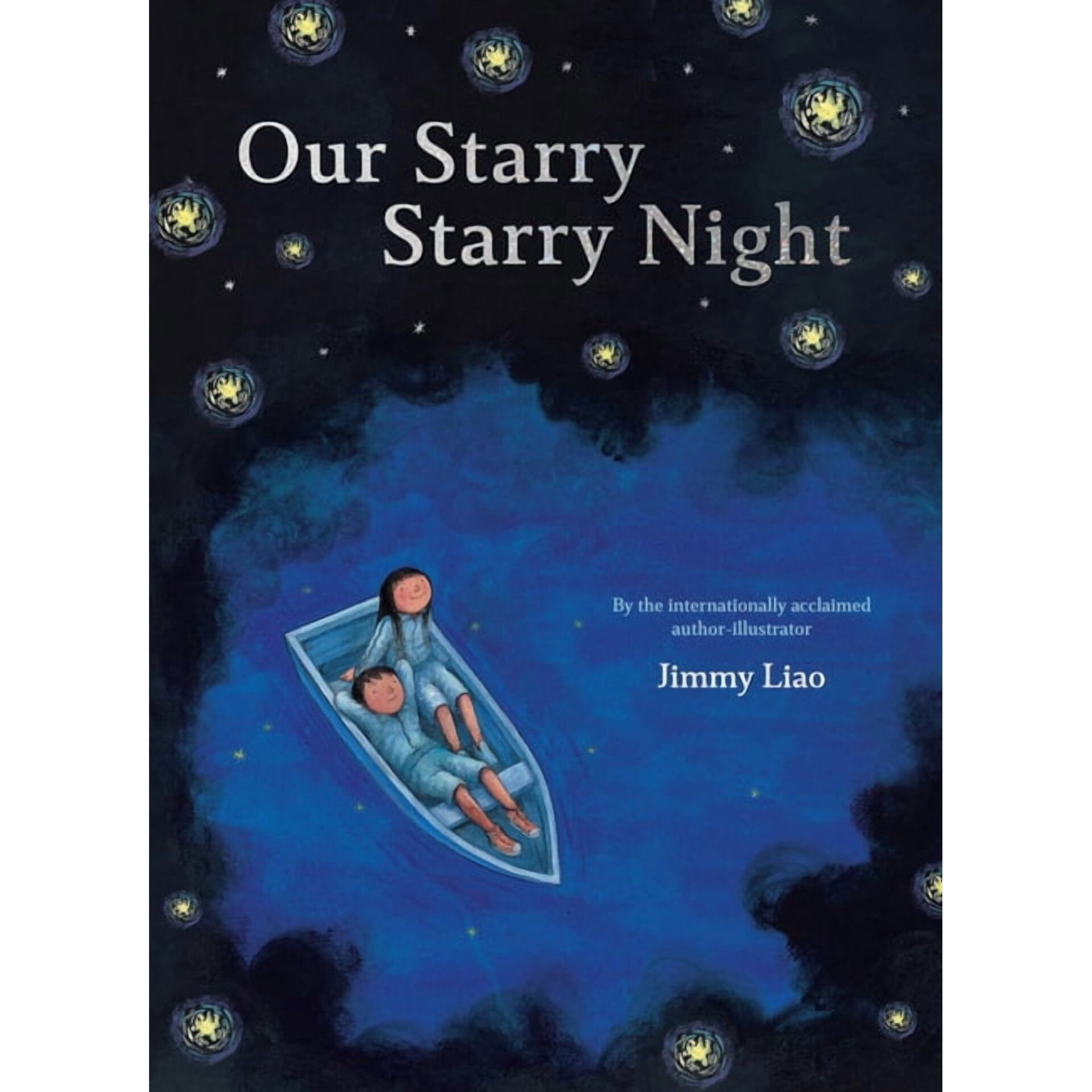
In Our Starry Starry Night, Taiwanese children’s literature legend Jimmy Liao illustrates the touching story of two young, fated friends. An awkward girl who can’t avoid troubles at home or school. A new neighbor boy who can only be himself by being by himself. The two are brought together as they navigate complex, inexplicable emotions. Because sometimes, when it gets hard to communicate with the wide, overwhelming world, all one needs is a friend to run away with—if only for one brief starry, starry night.
At the time that I’m writing this article, the English edition has lived up to its title with two starred reviews, which you can read here and here. These reviews are already very lovely and will hopefully convince you to read the book, so rather than write another review, I wanted to share a behind-the-scenes reflection on what it’s been like to acquire, translate, and edit a book from Taiwan, in hopes that you’ll reward our efforts by supporting this beautiful book, too.
Jimmy Liao’s Our Starry Starry Night was originally published in Traditional Chinese in 2009 under the title Xīngkōng by Locus Publishing Company in Taipei, Taiwan. Although I grew up visiting Taipei almost every summer (and would stay at my grandparents’ house in the very same district as Locus Publishing Company!), I’d never heard of Jimmy Liao until 2023, when I stumbled upon his books on the Books From Taiwan website. I soon learned that he’s truly a literary legend of Taiwan and one of the most renowned children’s book creators internationally. Allow me to list some of his accolades and awards:
- Multiple Golden Tripod Awards, which is the highest honor in Taiwan’s publishing industry;
- a Taipei International Book Exhibition Grand Prize;
- a Feng Zikai Children’s Picture Book Award, which is akin to the Caldecott Medal in the Chinese-speaking world;
- a Bologna Ragazzi Award in Italy;
- a Viselet Youth Literature Award in Belgium;
- an Art Category Annual First Prize from the Spanish Ministry of Education and Culture;
- a Silver Star Peter Pan award in Sweden;
- and nine nominations for the Astrid Lindgren Memorial Award, the world’s most prestigious prize for children’s and young people’s literature
The list of awards is nice to listen to, but as a bespectacled Chronicle Books editor, I needed to see something to believe it. Turns out, I already had. In Taiwan, all you need to do is walk outside, and you’ll see Jimmy Liao’s artwork come to life: at the convenience store, at the bank, and even on the public transportation to and from those places. For years as a small child, I used to walk past his “Moon Bus” art installation next to Taipei 101. I just never knew that it was created by a children’s book author.
Over the course of his career, Jimmy Liao has published over 80 illustrated books, which have sold over 3 million copies in Taiwan and China alone, and they’ve garnered over 180 translations in 20 different countries. As soon as I read Our Starry Starry Night, the poignant story of this special childhood friendship sparkled in my watery eyes. It’s no wonder Xīngkōng had already sold over 100,000 copies in Chinese and had already been translated into 12 different languages, garnering even more awards along the way:
- The Traditional Chinese edition won the Best Picture Book Award for the children and young adult books category in the 34th Golden Tripod Awards from the Government Information Office of Taiwan, as well as the Best Young Adult Book in the 2009 Open Book Award of China Times.
- The French edition won the Prix Sorcières 2021 in the Carrément Beau maxi category for outstanding artistic performance.
- The Portuguese edition won the Gold Award in the Best Illustrator Award for Foreign Children’s Books at the AMADORA International Comics Festival in Portugal.
- The Swedish edition was awarded a Silver Star by The International Board on Books for Young People (IBBY).
And yet, there was no English edition. My eyes lit up at the opportunity for Chronicle Books to publish this book in English, though amidst additional challenges, we had to confront a key question of acquiring any book from abroad: how would it translate to the United States? The question was both figurative (i.e. how would its success translate to our market?) and linguistic (i.e. how would its language/story translate into English?).
Here’s where the translation process began. The Taiwanese publisher, Locus, sent us a rough English translation for our review (as is standard in the world of foreign rights), and we came to a not-uncommon conclusion that the translated text wasn’t quite working yet in English. Our decision was that I could only acquire this book on one condition: I had to make the translated English text work for an English-speaking audience, especially our core audience in the United States. In theory, this is an ideal project for a Taiwanese American editor—to bridge that gap between my familial homeland and the country I’ve grown up in. The problem was, I could only read about every other word of the Traditional Chinese text. Like many of my fellow Taiwanese Americans, my Traditional Chinese education has felt fractured at beast: one stint from kindergarten to second grade in an afterschool Chinese class, and then a second stint from my freshman year through junior year of high school, culminating in my completion of AP Chinese. Alas, that’s not quite good enough to translate an entire children’s book by myself.
So, I did what many Taiwanese American kids do when struggling with Traditional Chinese: I asked my immigrant parents to help me translate. They had grown up in Taiwan before moving to the United States as adults, and they were happy to answer all my questions. I still remember one of the idioms that we got stuck on: “閒得發慌,” describing the boredom of the old lady next door. The literal translation is something like, “bored to the point of nervous agitation” or “bored to the point of panic.” The closest common English idiom would probably be “bored to death,” but the word “death” felt intentionally unused even when there was a death in the story. My dad smartly suggested “bored to tears,” though that didn’t quite capture the feeling, either. My mom struggled to come up with an English phrase at all and ended up acting it out by yelling, “I’m so bored!” while shaking her entire body like crazy. I told her she was out of her mind. “Exactly!” she said, pointing at me. So that’s what we ended up with: “bored out of her mind” (20). On the contrary, I wasn’t bored at all while learning from my parents, and I’m so thankful for their contributions to this project.
Next, I went through multiple rounds of editing the translated text for a U.S. audience. This meant occasionally deviating from a literal translation. For example, even the English title provided by the Taiwanese publisher, “The Starry Starry Night,” was not a literal translation of the original Traditional Chinese title, which actually means “Starry Sky.” Their choice to call it “The Starry Starry Night” emphasized the book’s artful connection to Vincent van Gogh’s famous painting, The Starry Night, in hopes of making the title more familiar for an English-speaking audience. Thinking of the U.S. audience, I took this edit one step further and adjusted the title to Our Starry Starry Night, in hopes that the “Our” would communicate to readers that this is a character-driven story. I should also point out an extra challenge of translating this children’s book; not only did the English text need to feel accessible for child readers that are still learning to read, but I also had to ensure that the first-person narration sounded like the voice of a child. At last, after months of reworking the text, we were ultimately able to acquire English rights. Still, the translation journey was far from over, as I still needed to get the edited text approved by the Taiwanese publisher.
While most of my edits up to this point catered to the U.S. audience, working with the Taiwanese publisher helped me make edits that preserved the original complexity of the Traditional Chinese text as well. I believe this complexity is best captured in the conversation we had about whales. The motif of whales first appears in the bookstore, where the girl sees the boy reading:
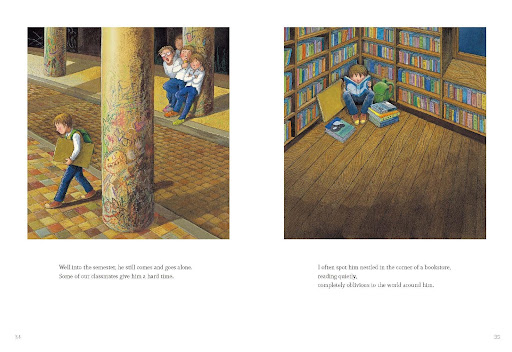
In the Traditional Chinese text, the word “whale” is not mentioned here, since it is already shown in the art. The next time we see a whale in the art, though, the Traditional Chinese text does seem to call it out:
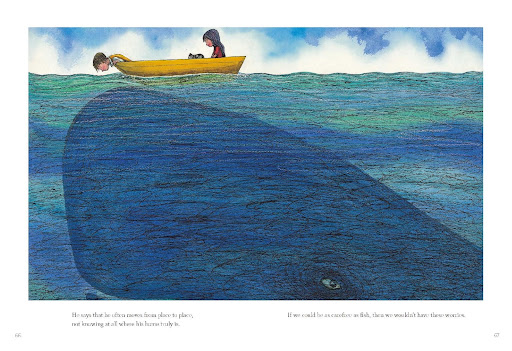
That is, the whale is implicitly referred to as a “fish” (67). In Chinese, the word for “whale” (“鯨魚”) actually contains the character “fish” (“魚”), and so in the Chinese language, a whale is a kind of fish, in a way. In fact, the first character “鯨” also contains a “魚” on its left side, and the “京” on the right denotes that whales are a big fish—“京” is often used for capital cities, so whales are like the most important fish. But in English, we lose that linguistic connection: whales are mammals, and fish are fish—and the words themselves have no obvious connection to each other. At first, I felt it’d be fine to chalk it up as a minor detail lost in translation. But my mind began to swim towards the end of the book, when the girl visits the boy’s room:
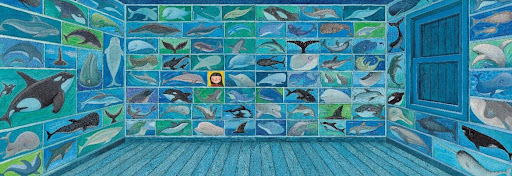
You may notice that this illustration is actually twice as wide than the previous spreads I’ve shown—that’s because this is a gatefold spread, in which two additional pages fold outwards like the doors of a gate, creating an illustration that is four pages wide. This special effect costs extra money, and publishers will usually only pay this extra cost if the impact feels worth it. Instead of an instant impact, though, I found that this illustration poses an incredible question for the reader: why did the boy paint whales all over his room, and why did he paint the girl’s face among them? Here’s what the Taiwanese publisher told me: “[Our] interpretation is that his heart had never left space for anyone else — only for the whales he longs for, symbols of freedom. Now, he has made space in his heart (his room) for the girl . . . he has reserved a special place for the girl — a place he has never given to anyone else (any human).” It’s an inspiring way to read this illustration, indeed, and one that connects the girl to the whales as “symbols of freedom.” At the same time, the fact that the Taiwanese publisher called this an “interpretation” means that there’s room for more interpretations as well. So, I started thinking through additional layers of interpretation, as I felt that the gatefold needed an extra impactful payoff to make it fully worth the extra cost.
As it turns out, it was only through the process of translation that I found such an impactful layer of interpretation. Because the Traditional Chinese text had already pushed me to think about “whales” as a kind of “fish,” I naturally flipped back to the first mention of fish in the story:
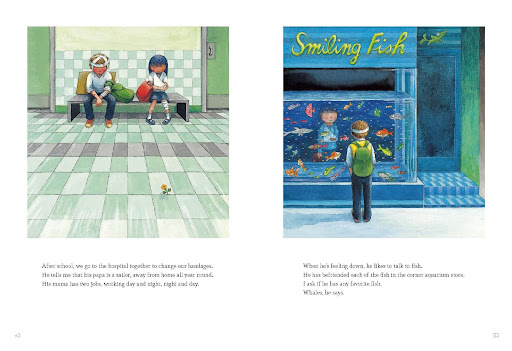
In the Traditional Chinese text, the last line of the page is “他們都是他的朋友,” which translates to, “they are all his friends” (in which “they” refers to the fish). If we remember that “whales” are a kind of “fish” in Chinese, we can think of whales as not only symbols of freedom, but also as symbols of friendship, too. Then, when we eventually get to that gatefold spread to see that he has painted the girl amongst the whales in his room, we can also interpret this illustration as follows: if fish have been established as friends, and whales symbolize the most important kind of fish, then the boy has decided to paint the girl as one of his most important friends. Therein lies the impact that hit me like, well, a whale. Yet this additional interpretation is lost in English once we lose the linguistic link between “whales” and “fish.” I soon realized I had to deviate from the original text in order to translate this layer of meaning. When I explained this situation to the Taiwanese publisher, they approved of my solution to add two extra lines to establish whales as an important kind of fish: “I ask if he has any favorite fish. / Whales, he says” (53). Admittedly, I’m still not confident that this was the correct choice, or if there was a better way to create this impact; after all, I made these characters say lines in English that they never said in Traditional Chinese. But such is the beauty of literature: there is not necessarily a “correct” or “better” answer, only different choices that we make to read the same book. As both translator and editor, I just wanted to preserve as many of those choices as possible, and I take full responsibility for any missteps along the way.
My name does not appear on the title page or the cover (and neither do my parents’ names, for that matter). Friends, family, and colleagues have all asked me why I left my name off the book. Perhaps it has to do with my upbringing, as my parents have long trained me to not draw attention to myself, and I think many Asian Americans can relate. I think it also goes back to another insecurity that’s specifically Taiwanese American: I’m just not good enough at Traditional Chinese. If we get another opportunity to translate a book from Taiwan, I aim to work harder so that we can proudly print a translator’s name in the book, whether that means making space in our budget to hire a professional translator, or improving my own Traditional Chinese to comfortably translate children’s books.
In the meantime, I humbly ask you to read and support Our Starry Starry Night, written and illustrated by the Jimmy Liao, unofficially translated by me and my parents. It’s been one of the greatest privileges of my professional publishing career to translate and edit this beautiful book. At Chronicle Books, it is the company’s first ever translated children’s book from Taiwan, and its promising success will hopefully resonate with readers, opening the door to translate additional Jimmy Liao books and books from Taiwan. And as we continue to create and cultivate what “Taiwanese American” culture is, I’m hopeful we can celebrate this translated book as a beautiful part of our culture as well.
Ian Tseng was the 2022 Betty L. Yu and Jin C. Yu Creative Writing Prizes Grand Prize Winner, College Category. You can read his work, Deconstructing Da’An Forest Park, here. Ian Tseng is the Editorial Assistant in Children’s at Chronicle Books, where he reports to Executive Editor Melissa Manlove and Senior Editor Naomi Kirsten, and he is now beginning to acquire books for his own list as well. He is deeply committed to furthering the diversity movement in children’s literature through publishing, editing, bookselling, research, education, reading, illustrating, and writing. More specifically, as a Taiwanese American who never really got to read Taiwanese books as a child, it has been a dream of his to find Taiwanese books that he can publish in the United States and share with more children here.
Related posts:
 Who Is Arthur Chu? Villain, Hero, or Anti-Hero?
 I DREAM OF POPO is the Taiwanese American story of all generations
 Coming of Age with Grace Lin’s “Year of the Dog”
 On playfulness, anger, mother-daughter relationships, and all the white space in between: Bo Lu (Bao’s Doll) in conversation with Mikaela Luke
Leave a Reply