
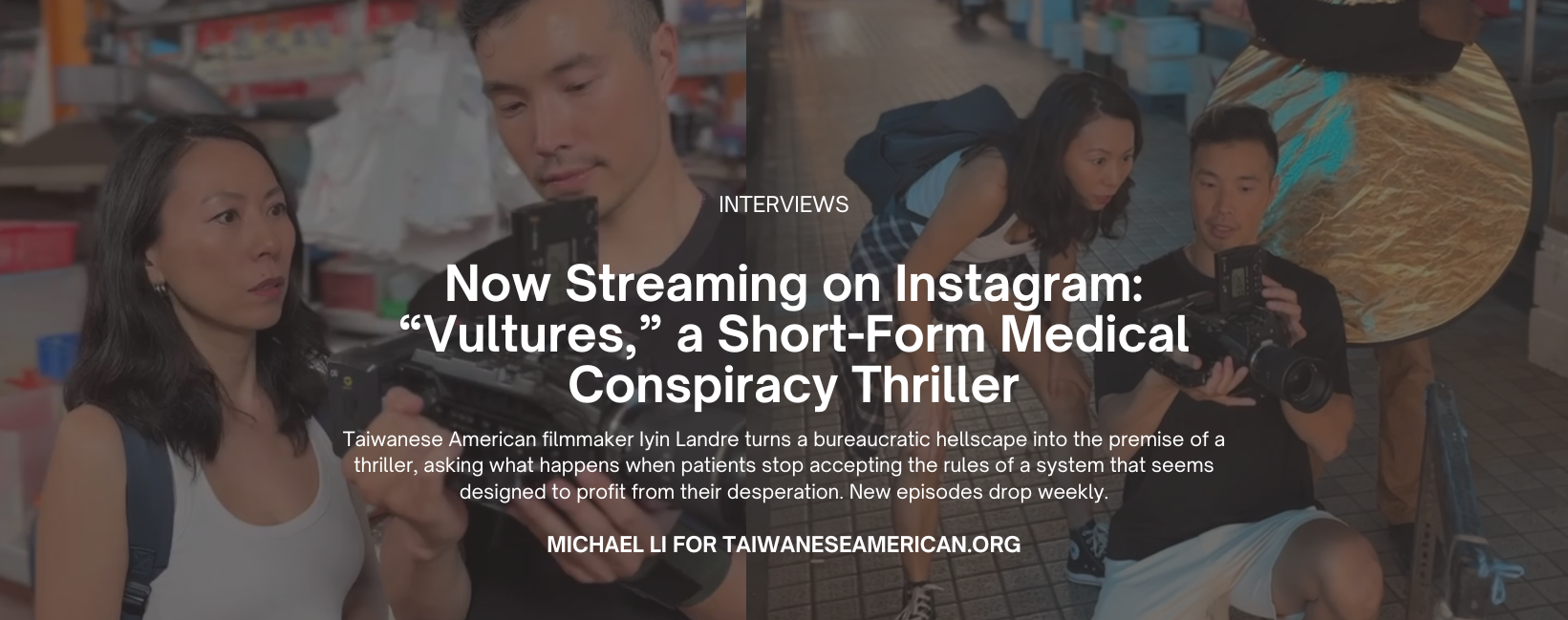
Taiwanese American filmmaker Iyin Landre’s new series, Vultures, is a short-form medical conspiracy thriller about what happens when an already staggering medical bill must be navigated within a healthcare system designed to make this care inaccessible, if not a further source of debilitation. The series follows Fiona, a woman trying to pay off the $300,000 in medical debt her sister, Cindy, has accumulated after a serious medical crisis. while gradually uncovering the corruption and corporate collusion behind the system that put them in such desperate circumstances.
In the first clip, hosted on the Vultures Instagram account, Fiona calls “Commune Health… the number one choice keeping Americans healthy” to ask why her sister’s treatment has been denied. An administrator tells her that they cannot accept the pre-authorization form.
“My sister,” Fiona pleads, “had a seizure so violent she fell in the shower and dislocated her shoulder. [The treatment] is not elective… it’s not lipo.”
The administrator responds with the barest of sympathies, and makes no meaningful effort to be more helpful. Under Commune Health’s rules, she says flatly, seeing a brain specialist is considered an “elective treatment,” regardless of the severity of Cindy’s condition.
With Vultures, Landre turns this bureaucratic hellscape into the premise of a thriller, asking what happens when patients stop accepting the rules of a system that seems designed to profit from their desperation. In this interview for TaiwaneseAmerican.org, “Vultures” Director of Photography Michael Li speaks with with Landre about the inspiration behind the series, the particular horror of American medical debt, and their creative partnership.
Michael: When you first reached out to me to shoot your vertical series “Vultures” I had conflicted thoughts because I tend to be old-school and prefer traditional widescreen aspect ratios. Did your inner filmmaker also in ways battle this new format and approach to storytelling?
Iyin: YES! Since the beginning of time everything has been shot horizontally, as have I in ALL my work. It felt like a cop-out to shoot vertically because we associate vertical content with mindless fluff and cheesy micro-dramas. But I think our viewing habits and our attention spans are changing, so I thought I would capitalize on this by making cinematic content with consequential storylines, vertically.
Michael: I’m happy I jumped on board immediately after an initial call and in-person meeting in Taipei. When you mentioned we would be filming in Kaohsiung, I smiled because my dad is from there. Being in the same place as where my family grew up, helps me connect more deeply and not feel as distant and detached as an American born Taiwanese.
How has creating “Vultures” helped you clarify or resolve your filmmaker identity, or allowed you to honestly express your identity as not limited to one place?
Iyin: I had been grinding in LA as an actor/filmmaker for years when Covid hit and life came to a standstill. I actually moved back to Taiwan for a while and reconnected with family and the Taiwanese part of my identity. But even after restrictions were lifted and I had moved to Europe, I still had no desire to tell stories or shoot anything; and since most of my adult identity had been predicated on making films and “making it,” who was I anymore? But looking back, as an artist I was in a gestational phase, just living and observing life and it was beautiful in its own way.
It wasn’t until 2025, five years after Covid, that I felt the urge to make something. And it wasn’t even so much an artistic urge as it was – we got poisoned by black mold in our Portuguese apartment and had to move out suddenly so we found ourselves in Romania for the summer – kind of urge. And one day I was flitting around in Bucharest as a tourist, I thought to myself, when would I ever be back here again?
Probably never, so I started brainstorming something I could shoot in Romania despite not knowing a soul, and that’s when I dreamt up “Vultures.” It’s a medical conspiracy thriller following a desperate woman who agrees to deliver mysterious packages to pay off her sister’s medical debt – only to uncover a global health crisis involving a hidden disease.
Michael: My identity as a filmmaker is always changing and I find it doesn’t neatly fit into one box / genre. In fact, that is what initially drew me into this fascinating industry, because it in ways connects everything and is relevant across all industries whether it’s movies, commercials, documentaries, or shorter form vertical narratives. How do you envision “Vultures” impacting your future career in film?
Iyin: The plan is to keep expanding “Vultures” with characters and storylines that evolve over multiple seasons. That’s something I haven’t seen in the vertical space yet, especially in the thriller genre. The goal is to give people a reason to come back and follow where these characters end up. In addition, each season is also set in a different country – Romania for Season 1, Taiwan for Season 2. I want people to ask, where is Season 3 going to be?” And I hope to build an audience that is just as interested in the characters as they are with the social impact that healthcare and big Pharma plays in our lives. For future seasons, I’d like to have more episodes and bigger storylines following multiple characters, but since I’m funding this with my savings currently, I am limited in the scope of the project. So if anyone wants to support a fellow Taiwanese American person making some art, feel free to buy me a Kofi and support the series, link below!
Michael: As a DP, I’m always open to constructive criticism and different approaches to improve my filmmaking skills. Having worked with many DPs, are there any aspects of our production in southern Taiwan that you would tweak to further enhance our production efficiency? Are there aspects of DPs that you specifically look for, especially for this newer vertical narrative format?
Iyin: I do think shooting vertically is a different beast and anyone who says it’s the same as shooting widescreen, I’m a little skeptical of. For one, the frame is super squooshed so you can’t have ten people sitting at a dining table in a wide shot like you can with a wider aspect ratio. That means mediums and close-ups play more and you’re cutting to wides less frequently. And this does change the way you tell the story because now there’s a lot of height but very little width in the frame. So in a way, it’s harder to make things look cinematic because there’s less foreground and real estate to work with. I kept saying “let’s dirty the frame!” because for me, when there is more depth of field, it makes things look more cinematic.
But in terms of our shoot, I think it went very smoothly considering it was the first time we worked together! The only thing I would say is to have had a wider lens for the scene at Fiona’s uncles’ apartment, so we could’ve also gotten a wide shot of Fiona and her uncle sitting at the table together, to create more awkwardness between them, cinematically. Otherwise, in general, I’m always looking for my DP to fill in the gaps in terms of what shots I may be missing for coverage because the worst is when you are editing and missing a shot to connect the story!
Iyin Landre is an actor and filmmaker. She initially moved to LA to pursue acting, but after auditioning for one stereotypical role after another, she decided the only way she was going to tell the type of stories she wanted was to write it and make it herself. She taught herself how to direct, write, produce, edit, color correct and sound mix. Over the span of her career, she has made a feature film (in Brazil), many music videos and documentaries and over eighty short films.
Lastly, as a filmmaker pushing the envelope of representations of Asian American women in media, she shies away from model minority depictions and leans into grittier and edgier stories that electrify.
www.instagram.com/vultures_series
Michael Li is an Engineer and Director of Photography with 15 years of experience building products, solving technical problems, and leading complex film projects across five continents. His career has taken an unconventional path: after a B.S. in Mechanical Engineering and Master’s in Product Development from Carnegie Mellon University, he spent the past decade building and running an international film production business while working with clients including Google, Bloomberg, Uber Eats, Netflix, and Discovery Channel.
https://www.facebook.com/michaelnolimitsli/
https://www.youtube.com/@michaelnolimitsli
https://www.linkedin.com/in/nolimitsli/



Leave a Reply