
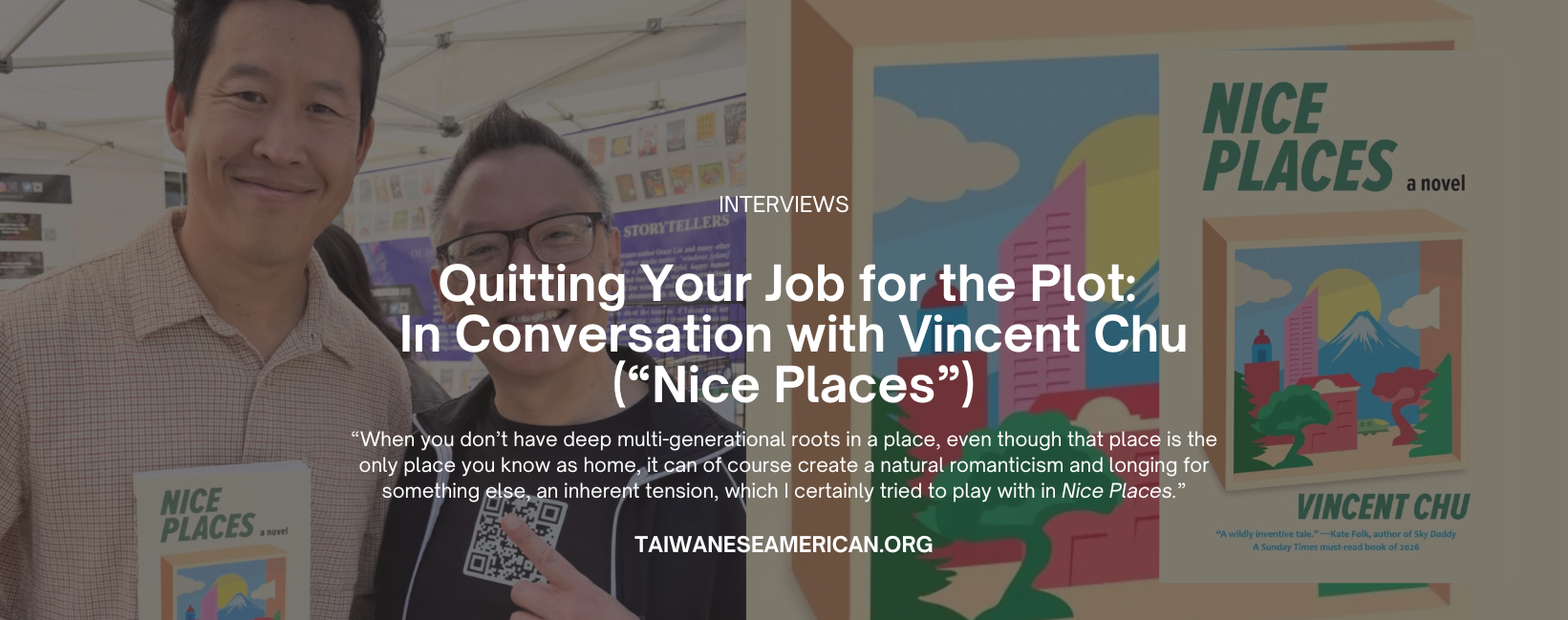
In Vincent Chu’s debut, Nice Places, the well-worn pilgrimage novel is reincarnated as satire for those of us who earnestly and anxiously poll our friends every Monday: “chat, should I quit my job?” The book follows an everyman– bored and unfulfilled at his corporate job in account management – in an unnamed hometown, the inner-city belly of which he has apparently never seriously explored. After the LinkedIn theatrics ritualizing a job termination (the circumstances of which… recollections may vary), the protagonist embarks on the trip of a lifetime – which is to say, he tells everyone about it and basks in all of its flattering implications: sophistication, worldliness, courage.
Not everyone, though, finds his adventurous spirit admirable.
“I think a trip will help me figure things out,” he tells his immigrant mother.
She responds, “you should have already figured things out! People travel the world after university, not ten years into a career… What do you hope to discover out there? Poverty? Danger? Loose morals?”
Throughout the novel, Chu expertly collapses the serious into the silly. Even the protagonist’s name, Georgie, gestures toward something classical, only toppled, topsy-turvy, onto its side. The main tension in Nice Places is not that Georgie’s mother disapproves of the ethos of “losing yourself to find yourself” (though she is certainly disparaging of the consequential employment gap). The central conflict is actually that, before he even leaves the city, Georgie is robbed of all of his relevant possessions and documents by a monk, and quite literally can no longer afford to lose himself.
Yet through an absurd, delightful chain of deceptions and encounters with an endearing cast of characters, Georgie finds himself anyway.
In the end, Georgie– and who among us is not a kindred spirit of his— reminds us that home and community, both valorized as elusive destinations to be sought and pursued, have always existed right beneath our feet.
We’re pleased to share this Q&A with Taiwanese American Oakland-based writer Vincent Chu.
Leona: There has to be a literary category for a bildungsroman of the jaded corporate class. You shared in the acknowledgments that Nice Places was partly inspired by your own experiences traveling, but do you also have a personal connection to Georgie’s circumstances? How has your own upbringing and identity influenced your writing?
Vincent: Maybe like other writers, I sometimes view my characters as both avatars of myself and also crazy people who couldn’t be more different from me. This is kind of the case with Georgie in Nice Places. We differ in a lot of ways, but I do have personal connections to his circumstances. I have quit my job before, and been laid off, and have left home to travel, convinced that the answers were out there and not here. Like Georgie, I’ve also suffered from daily existential discomfort, the question of ‘what are we even doing here?’ being particularly compelling in earlier stages of my life.
My upbringing and identity have certainly influenced my writing. Growing up in the Bay Area, I mostly felt encouraged and welcome to be authentic, and that, especially when it comes to writing, it can be okay to not justify or adjust your ideas or perspectives for a broader audience. I usually try to have that matter of factness in my writing, that intimacy of, ‘you know what I’m talking about.’ When it comes to travel, both how we think and write about it, I think being a child of immigrants (my dad is from Hong Kong and my mom is from Taiwan) helps in interesting ways. When you don’t have deep multi-generational roots in a place, even though that place is the only place you know as home, it can of course create a natural romanticism and longing for something else, an inherent tension, which I certainly tried to play with in Nice Places. Our country is full of people grasping desperately for a better understanding of, and connection to, their roots, through limited data, and that provides space for a lot of beautiful distortion. I thought Georgie, a man who’s never traveled but is simulating all these worldly destinations, could be a wonderful, and funny, vessel for some of these ideas.
Leona: What are some of the real travel experiences that have been formative for your creative life? Where are some unexpected places that have become “nice places” to you?
Vincent: In my early 20s, I quit my job and got rid of my apartment and flew to South America, not knowing exactly what my plan was or when I was coming back. I realize now that I had at that time already a strong desire to write creatively, but I was so clueless, so helpless, I was essentially giving myself extended time and space to read, write, and think — via this very solid and well-thought-out strategy. Surprisingly, it kind of worked, as I did do those things while traveling around. I didn’t come out of the experience with anything to show for it, but it did lay the groundwork for my creative life that would follow, and how to balance such a thing with everyday life back home.
Leona: I have to ask—since one of the central themes of Nice Places is the performance of the self on social media: how much of that irony has been part of your own experience as a debut novelist, as you’ve shared your adventures and experiences on Instagram and elsewhere?
Vincent: I have recognized that irony, as I’ve been shamelessly promoting my book on social media as of late. Up until this book was happening, I had essentially been off social media for around 5 years. And when I say “off,” I mean of course I was still lurking in the shadows closely observing and judging my friends and peers, but I didn’t actively share anything. One of the world views of this book is that social media is absolutely a performance and totally absurd, but it’s not all bad. That said, it has been fun getting to connect with a lot of amazing people, and share what I hope is an authentic, just curated, depiction of a few of my experiences as a debut novelist.
Leona: If Georgie had pretended to go to Taiwan, where would he have claimed to be, and how would he have constructed the photo and post?
Vincent: Early in their deception, Georgie and Ant make up a rule that there can be no food photos. That would be too easy and understandably go against their rigorous value system. That said, food-adjacent photos are fair game. I’ve been really enjoying the latest Taipei Night Market novel by Ed Lin, so maybe I would go with the Shilin Night Market. Georgie and Ant could rally some of their pals from Little Constantinople to be background patrons and diners and tourists, and with the right angle and distance, a few homemade signs and colored light bulbs and their trusty fog machine could help bring the iridescent charisma of the famed night market to life.
Vincent Chu is author of the debut novel Nice Places (Forest Avenue Press, 2026), which won the IPPY Award Bronze for Literary Fiction, and story collection Like a Champion (7.13 Books, 2018). His fiction has appeared in Muumuu House, STILL Magazine, Pithead Chapel, PANK Magazine and elsewhere. Vincent is a Hambidge Fellow, former Headlands Center for the Arts Affiliate Artist, and Pushcart Prize nominee. He earned his Bachelor of Arts from UCLA. Vincent lives in Oakland, California.


Leave a Reply