
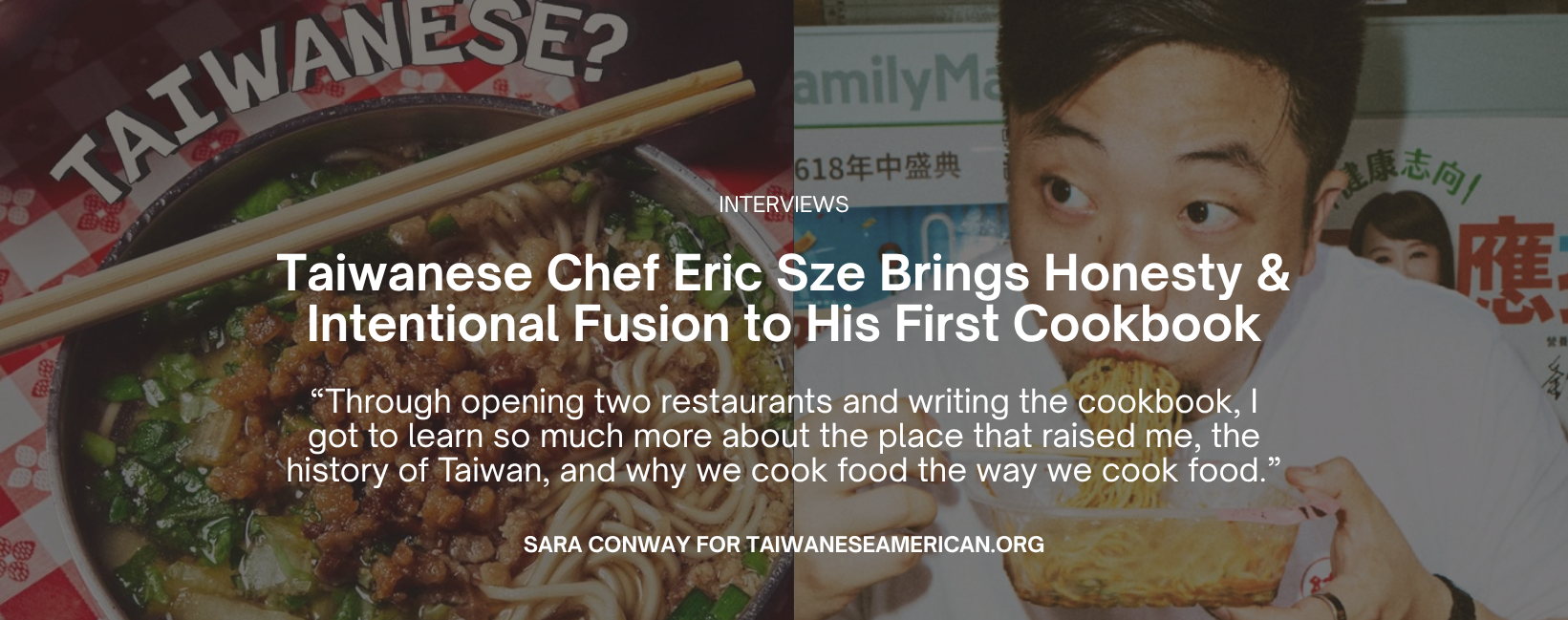
In order for fusion dishes to work, Taiwanese chef Eric Sze uses one thing to guide his “eccentric” cooking: The sum needs to be greater than the parts. Or as he explained to me when we met at his Greenpoint restaurant Wenwen, “one plus one needs to be greater than two.”
Sze is well known for his “authentically unauthentic” dishes. Born and raised in Taipei before heading to the United States for college, he questions what is considered “Taiwanese” food through his experimental cooking. He first learned to cook the Taiwanese dishes he missed while in New York; now he plays with the cooking techniques he knows and the ingredients he understands. Sze flips them on their head, making something new that maybe could’ve only been created between Taipei and New York City. (See: BDSM chicken, otherwise known as as “debrined, deboned, soy milk chicken.”)
But this cooking journey of “intentional fusion” didn’t come without its stumbles, as Sze recounts in his first — and most likely last — cookbook, Taiwanese?. The cookbook features 75 recipes, personalized travel itineraries, and rambling reflections on things like the rocky opening of the now-shuttered 886. “[I’m] proud of all the stumbles we’ve taken because we’re always picking ourselves back up,” Sze told me.
I met with the chef, restaurateur, and new cookbook author on a sunny July day to chat about Taiwanese? and why Taiwanese cuisine deserves more attention.
*This interview has been edited for brevity and clarity.
Sara Conway: Why is now the right time for you to write and publish your first cookbook?
Eric Sze: Well, this book actually took four years, so I didn’t know that. *Laughs*
I knew that the cookbook wasn’t going to be a financial driver for me, personally. I knew that I could afford to take my time; my living does not depend on it. But it’s very much a passion project and everything needed to work out. When I was approached in 2021 to do a cookbook by an agent, every person in the restaurant industry that I admire have either written a cookbook or is writing a cookbook. It seemed like an honor to be able to join that group of people. I had no idea what I was signing up for.
Luckily enough, we have Elyse Inamine who co-wrote the book with me. She really deserves way more credit. I was in ESL until ninth grade, so my writing skills [aren’t] the best. With every topic, she really helped me dive deep [through] the questions she asked me during our interviews. She helped me dig into my memories, almost like my unconscious self, bringing up these things.
I had always known that I wanted to call it “Taiwanese?” with a question mark because it’s a big question mark. But how do we take my story and present it in a not-too-cliché fashion? Even though the book is personal, I still want it to be more of a statement for Taiwan. Everything from the design to the photography and to the language used to the recipes, that is all the polar opposite of what I see, at least, the Taiwan media landscape has.
I grew up in Taiwan, and my view of Taiwan is very vibrant, it’s very, very dynamic. I feel like the portrayal of Taiwan, at least in the international lens, is very docile. Taiwan is very loud and it’s very outgoing. If Taiwan was a person, it would be a very E人 (extrovert). So I wanted to make sure that this book is a very good representation and like a postcard for Taiwan.
And I do view this book as the first and final book that I will ever write.
Sara: How did you come to collaborate with Elyse Inamine?
Eric: Elyse and I had worked on a Bon Appetit feature on how to hotpot. So that was a five, six-page master spread, and she actually got nominated for a James Beard Award. Because we had worked on that, and during that time period we were very intensely working together, I mentioned that I signed an agent. Then she left Bon Appetit and turned freelance, so she texted me — I still have that text — like, hey, in case you need a co-writer later, I’m here.
It was a no brainer; I didn’t speak to anyone else.
But pitching the book was difficult, because the combination of timing as well as Taiwanese food being a niche subject and me not really being a big shot meant that our crazy book proposal was rejected by a lot of publishers. Way more than we anticipated. So it took a long time, but we found the right partner in Hardie Grant, and they gave us a lot of creative freedom.
Sara: How did Alex Lau come to join the cookbook team? How do his photos capture what you want to say through the cookbook?
Eric: Having Alex Lau do the photography was a great honor. The way we shot it was very run and gun. We had three minutes of actual good shooting per shop and nothing, truly, was planned. We planned to go to these shops, but we can’t make reservations at a lot of them. For all these shops, we showed up, Alex with a bunch of gear. It helps that I speak Mandarin. I had to like swing [the owners] into it and persuade them. That’s the mindset behind the cookbook.
It’s really fun because through opening two restaurants and writing the cookbook, I got to learn so much more about the place that raised me, the history of it, and why we cook food the way we cook food. I feel like I’m only scratching the surface. Being able to present [the cookbook] to maybe a more western audience or wider audience, I think I’m very lucky in that sense.
Sara: Can you talk more about how missing Taiwan drove you to teach yourself how to cook the Taiwanese foods you missed and how this eventually opened up a path to experiment with those nostalgic dishes?
Eric: I spent the first 18 years of my life in Taiwan and came to New York for school. It was culture shock. I actually had a really interesting conversation with a friend, she was like how come every person living abroad, when they come back to Taiwan wants to eat beef noodle soup? Why?
Then I thought about it, and I came up with a very, I think, accurate answer. It’s because when you’re living in Taiwan, and you’re walking in Taiwan, there’s so many beef noodle soup stalls that you’re constantly seeing beef noodle soup. You’re constantly smelling beef noodle soup that it’s almost pounded into your subconscious. When you leave that environment, you’re almost in withdrawal. When I go back to Taiwan, I’ll have a beef noodle soup, and then I won’t eat another beef noodle soup for a while. But then when I leave, I’m just missing that beef noodle soup for no reason. But actually, no, it’s because the environment is gone.
So when I left for New York and came here, there was no more environment for me. In order to feed my addiction to Taiwanese food, I had to learn how to make it myself. Luckily there was YouTube back then. This was 15 years ago. I started from there.
I’ve always been curious, and that goes back to the more I cook, the more I know, the more arsenal I have. The more arsenal I have, the more ways I can be creative and fool around with food. And here I am today.
Can you explain more about what you mean by “intentional fusion?”
Eric: Every cuisine sort of has its own fusion roots like Taiwanese food is a classic example. But I wouldn’t say it’s intentional.
There is a whole school of chefs who are Asian, have Asian backgrounds, love Asian food, who love every cuisine on the planet. But we want to represent our own cuisine. In the same breath, we want to put our own stamps on the cuisine, and that comes with certain expectations, especially market expectations. If you open a restaurant, call it “Taiwanese,” and you don’t serve these things, people will be pissed. But it’s okay — as long as it’s delicious.
But intentional fusion is us trying to put our own stamp on the cuisine and utilizing our creativity, our techniques, our learnings throughout the years. Sometimes it’ll be great, sometimes it won’t be great. The numbers and the customers will decide what stays on the menu.
Sara: What did your decision-making process look like regarding which recipes to include in your cookbook? What was your criteria?
Eric: Honestly, it’s so much more simple than it looks. It’s what I wanted to be [included] — that’s basically it. *Laughs* One of the recipes that I really like from the restaurant are the ones I really liked growing up. That’s it.
Sara: In your recipe for Banquet-Style Pineapple and Shrimp, you give a shoutout to the sprinkles and how “little sense it makes.” How does this reflect your perspective on food, especially on Taiwanese cuisine?
Eric: I feel like pineapple and shrimp is a shining example of what kind of attitude we should approach food with. I think with social media, with the amplification of Michelin, and all of these idolization of fine dining, food is now way more engineered than it was ever. The idea of sprinkling sprinkles on top of pineapple and shrimp just because it f*cking has color…I think that’s an attitude we should take.
Sara: Why did you want to emphasize knowing cooking techniques and understanding the elements of a dish before trying to experiment?
Eric: Food and cooking is all about ingredients and techniques — and that’s it. If you break down every single ingredient of every single dish you can see sort of the blueprint of it. Then, if you have the historical context and you have enough of a database to know what works then it becomes really fun. Then you have a lot more weapons in the arsenal.
Sara: Why did you want to add themed itineraries to your cookbook? What did the research process look like to create these itineraries?
Eric: This book, ideally, is for people who are interested in Taiwanese food and interested in Taiwan. In opening 886, one of my macro goals was to introduce Taiwan to people who have never been. And that’s a perfect place to do it. If [somebody] who comes to 886 is introduced to Taiwanese food and [is] eventually interested enough to go to Taiwan for one of their vacations, then, to me, it means I have accomplished some sort of mission. And a lot of people have done that, actually.
Sara: What are some questions you still have about Taiwan, Taiwanese food, and Taiwanese identity?
Eric: If we had a time machine, what does Taiwanese food look like [in a decade]? That’s something I’m very interested in.
Sara: What would you like to talk about that I didn’t ask about?
Eric: I would love Taiwanese folks to realize — and maybe they already do — the beauty of Taiwan. The ingredients, the people, the surroundings. I think Taiwan is so worthy of us appreciating it. Maybe it’s just me, but when I was growing up in Taiwan, I was taught to appreciate things outside of Taiwan. Not saying that my family hates Taiwan, not at all, I just think there’s this weird sense [that] other people’s things are better than ours.
I believe this mindset is changing, but I would love to push it forward even more. We have some of the best select ingredients in the world: cabbage, I think best in the world; fruits, best in the world; I think our pork goes toe-to-toe with Iberico. Our people, some of the best in the world.
And I think it’s good to be proud to be Taiwanese. I think if we can push the mindset [to] really appreciate our own culture a little bit more, that would be great. And there would be a little more unity. Taiwan is a small place; it technically should be easier to be united, but so many people are so divided.
Sara Conway is a Chinese American writer based in New York and Taiwan. A lover of a good story and a good song, Sara is the creator behind the bookstagram Lyrical Reads and the digital editor at EnVi Media. She also has published her writing in places like Timid Magazine, GRAMMY.com, Clash Music, and JoySauce. Although books are her number one love, you can always find her learning Mandarin, heading to another concert, or petting all the cats she sees.


Leave a Reply