
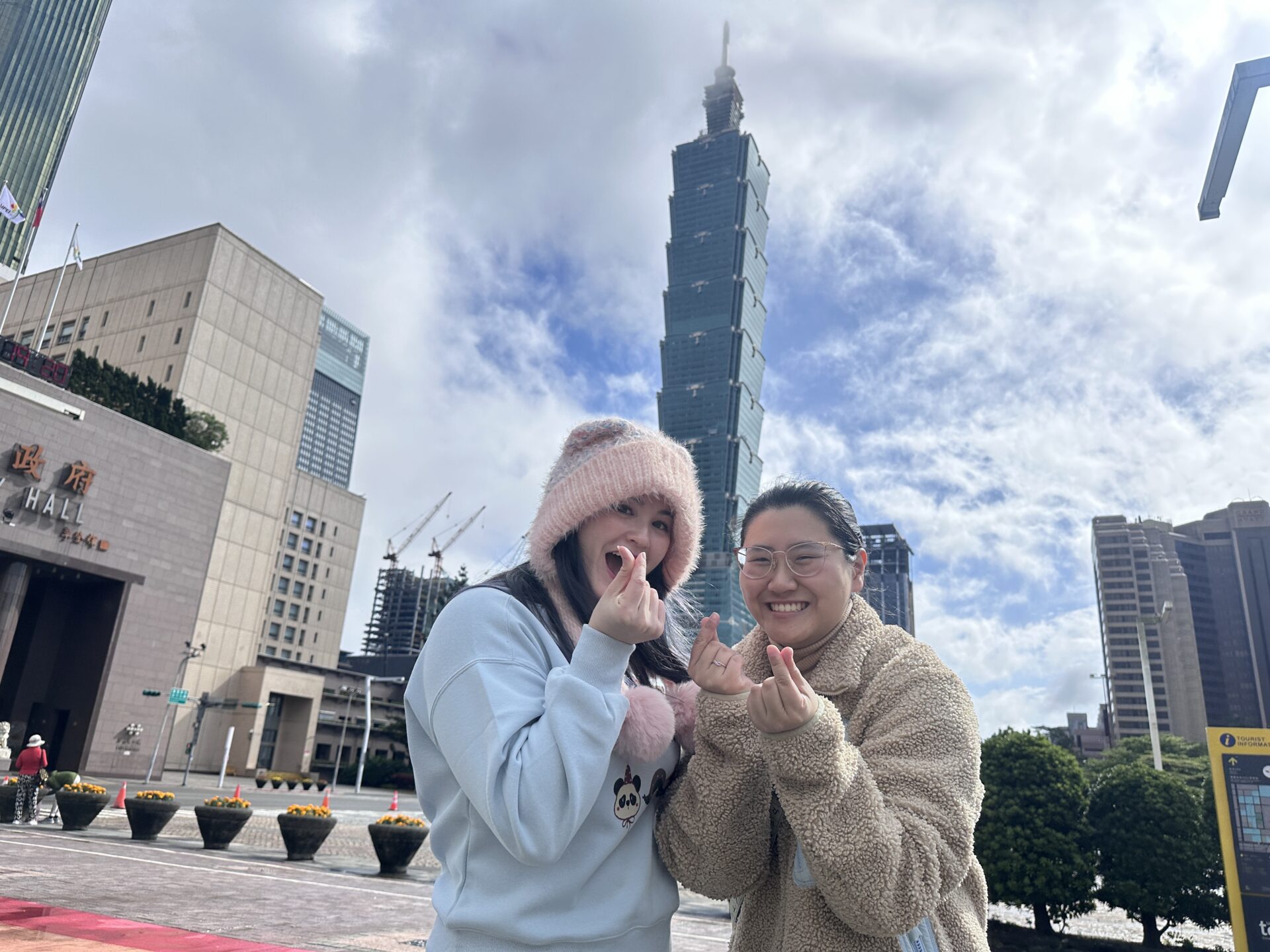
We hadn’t meant to cry in the food court below Taipei — and during a Saturday lunch rush hour at that.
Author Stefany Valentine and I connected online in 2024 before she published her debut novel, First Love Language. As Asian American adoptees — her being Taiwanese American and me being Chinese American living in Taiwan — we bonded quickly over Taiwan and our longing for adoptee representation in young adult books.
Fast forward one year and suddenly we were meeting in person in Taipei. When we first started chatting, I had been studying Mandarin in Tainan; Stefany was interested in learning Mandarin in Taiwan. Since then, right before First Love Language was released, Stefany is in reunion with her birth mother in Taiwan.
Now we’re both living in Taiwan: I work a corporate job in Taipei; Stefany studies Mandarin in Taoyuan while living with her birth mother.
A week before Stefany’s sophomore debut, Love Makes Mochi, was released on January 27, we met up at Taipei 101 to chat about (re)-learning Mandarin as adoptees in Taiwan. But what we didn’t expect were the tears, the climbing of an emotional building with no ropes (on the day Alex Honnold was originally scheduled to climb Taipei 101), or the feels from having a conversation with someone who just…gets it.
*This conversation was edited for clarity.
Sara Conway: What was your first day of school like?
Stefany Valentine: When I first got here, [Taiwan] was definitely really hot, but at the same time I was just so excited, so starry eyed, like “I’m totally going to learn this language so quickly because I’m so passionate about it; I want to learn it so fast.”
Not gonna lie, I think because I’m adopted and technically Mandarin was my first language, I came back thinking, “OK, it’s gonna come back to me because it’s in my blood.” I felt this kind of unrealistic expectation of learning Mandarin very quickly and being able to speak it well quickly.
I wanted [that] so badly because I wanted that feeling of “I’m enough, I’m Taiwanese enough.”
I’ve spent my entire life proving… *starts tearing up* I wanted it so bad. Now as a student, I’ve been here for six months and I’m actually gearing up for my finals, I’m like “Wow what was I thinking.” Like this is a whole [distinct] language. It takes years to perfect it.
I think a lot of the time, too, when you’re thinking of learning Mandarin, you think of the tones and the vocabulary. But there are also things you don’t really think about — like grammar. It’s something you have to practice. It’s like learning mathematical equations but instead of using numbers, you’re using words and you’re plugging them in to create a meaning.
Then you also need to learn nuance, which is where you [incorporate] the cultural aspect of it, so like slang. For instance, this is a very common word or a common phrase that I’ve started using lately: 不好意思. The textbook tells you to say 不好意思 (bù hǎoyìsi) and that means excuse me, but the way locals actually say it is a one syllable so like “baoyisi.”
SC: As an adoptee learning Mandarin, I feel like there’s this additional unconscious — or maybe semiconscious — stake.
I started learning Mandarin in sophomore college and [I was] the only Asian in that room, the only Chinese person besides my teacher. I [knew I was] in the beginners class, but I [had] this internal pressure of “You have to be perfect at it.” You know that it’s not a realistic standard, but you still have that pressure.
On the first day of my Mandarin class [in Taiwan], it was actually refreshing to see that my classes were majority Asian people. I still felt that pressure a little bit but, over time I was like “OK, you are also learning this and you are getting better.” But it’s not realistic to [think] “You need to be perfect” when you lost the language.
SC: Can you take us into your classroom environment and what your class looks like?
SV: I’m studying at Chung Yuan Christian University (中原大學); I have the Huayu Scholarship. Thank you again for helping me with that. I wouldn’t have this incredible opportunity without the scholarship, so I’m super grateful.
There’s about 15 students in [my classroom], and I believe 10 of those 15 are Vietnamese students. We [also] have an Indonesian student, a Filipino [student], two Americans, one from Türkiye. It’s been interesting because [I’m] hearing Mandarin from a Vietnamese accent a lot of the time in that class. I’ve also noticed when I speak with my American classmate, I definitely understand him a little bit better than everybody else. I think it’s because my ears are just geared towards the American accent.
I really love my teachers. I have a 大老師 (dà lǎoshī) and a 小老師 (xiǎo lǎoshī.) My 小老師 only teaches for one hour, and what he teaches is reviewed material. I’ve forgotten some of the words from my first semester, so I’m able to revisit those words.
My 大老師 teaches the new material. I love how she talks to us in a Ms Rachel way, and I don’t mean that in an infantilizing way; it’s more like [大老師] understands we are still learning. I love that she is so seasoned in her teaching that she just knows she needs to exaggerate the way she speaks in order for me to hear.
I feel like [my 小老師] also teaches so [well] because I see the way he thinks. He thinks like someone who is learning a new language, so he’s really slow, really repetitive…He understands that repetition is key. They both are really good at knowing where the building blocks are and helping us grow from there.
SC: I was so scared on my first day of school — like absolutely terrified, especially after I learned everything was in Mandarin. But I really appreciate my teacher’s teaching style.
She was super into repetition and repeating back what she said. You [had] to actively think, “What exactly did she say?” instead of reading off the board. That was definitely high pressure, and I definitely wasn’t the most relaxed in her class. *laughs* But I think this being the first building blocks of Mandarin school really helped create that foundation [for me].
SV: Yeah, it’s really so cool because from now on, my teachers are literally shaping my future with the language. I imagine it must be really cool for [our teachers] to be like, “I’m like shaping their minds.”
SC: How have you navigated re-learning what is technically our native language?
SV: *starts tearing up, sniffling*
I think giving myself grace is the ultimate lesson that I’ve come to at the six month mark. Who knows, maybe after another six months I’ll feel a little differently. I think I went into it giving myself these unrealistic expectations of almost feeling like it’s owed to me and it will come to me so much quicker because it’s already mine.
But then [I’ve been] grappling with the fact that no matter what, I did lose it, and this is a part of that “getting it back” process.
I’m always so proud of myself whenever I cry. It tells me that there’s so much more I need to process, so much more I need to learn about myself. So anytime I cry, it’s me being vulnerable with myself.
I’ve had to slowly chip away at the fact that a part of a loss is that it really is gone. Yes, I’m in reunion with my biological mom. Yes, in a sense I “got it back,” but the language is gone. That’s why it’s so difficult for me to learn and I’m confronting this straight in the face now even though I wanted it for so long.
I’m so happy to finally be here, but it sucks that you can want something so badly. You can finally in a sense have it back and you [still] have to cope with the fact that “I will never get those years back.” I will never have the spongy brain of a child learning this language.
[But] even though I’m in reunion — I found my biological mom — I totally don’t blame any adoptees for not wanting reunion because it is such a difficult process to go through. Because not every reunion is going to be like “Oh my God, I’ve been looking for you my entire life” or “Oh my God, I’ve missed you.”
It’s [can be] confronting a lot of heartache. It might turn out like: “Oh, you found me. I want nothing to do with you.” Shortly after I was reunited with my mom, she said that she wanted nothing to do with me. And I could not get out of bed [after that].
I have adopted friends who are in that state right now, but they’ve been in it for years. For me, I was only there for two weeks before my mom was finally like, “You know what, you’re right. I will open up to you.” So, I totally don’t blame people for not wanting to even go near that because the level of a trauma that comes from that is debilitating.
I feel like it’s strange being an adoptee because you can have that ugly cry while wearing a smile. It kind of sums up the adoptee experience because you do have to sit with polarizing emotions.
SC: I don’t remember when I thought of that question, but I often think about when people ask, “What’s your native language?” Usually I’ll say English. But I was in China for one year, so there must have been a lot that I understood. Being in an orphanage might not have helped [with language development], but we [also] had foster parents.
I remember seeing some of our old medical records. There were notes from our foster parents [about] my sister and I. I guess they called me 念蘭 (niàn lán), my Chinese name, [and they wrote things] like, “She really loves colorful things…”
*pause full of teary laughter because…adoptee trauma*
Re-learning Mandarin reopened some of those [wounds]. But I’m a Type A, especially with studying, so I was able to just focus a lot of attention on that. I think I stopped comparing myself to others [as much] in class once I realized it’s my personal journey, and [my classmates], they’re also on their personal journey.
So, yeah, I say that English is my first fluent language, and Mandarin is my native language because that’s the language we probably knew first.
SV: I call it my heritage language or my mother’s mother tongue, if I’m being fancy.
I think as adoptees, we have our own language. I know some adoptees who refer to [us adoptees] as legally trafficked people because like that’s how they view their adoption. And[it’s] perfectly valid because I see where they’re coming from…I think as adoptees, we do speak our own language.
SC: What was your first impression of Taiwan when you came back?
SV: I was finally able to be like, “I f*cking knew it” — that sort of a feeling. I have dreamt of this place, where the trees are a shade of green you will never see anywhere else in the world. Then when I came to Taiwan, it was like, “That’s the shade of green; that’s Taiwan green.” I remember that.
I grew up here. This was where I started going to school. I went from being this girl who was like, “Oh wow, this is what life is like; oh wow, this is what school is like; oh wow, I get to walk out these streets.”
Then I moved to the U.S., and my mom was forced to relinquish me. My biological dad died, so it was just me and my stepmom.
It was so incredible to come back [to Taiwan]. Even though I lost it, and I had to live a life of never knowing it, I still remembered it in my dreams. I would have these dreams…
*tears again :’))*
I would have these dreams, [where I was] walking down a city [street]. I don’t remember what that city was, but I would wake up with that feeling of wanting to go back. I just wanted to go back to sleep so that I could go back.
When I was at the train station [recently] with my mom, I was just sitting on the bench looking out at the skyline. I was like, “Oh my God, this is the city. This is the city I dreamt about.” My mom still lives in the district that I grew up in, so when we were at Taoyuan Station, there’s a field and you can see more of the skyline. I remember just staring at that specific skyline.
On a conscious level, I didn’t know that I was dreaming of Taiwan. I thought that…you know, when you dream you kind of make shit up. But no, it was my subconscious remembering Taiwan [since I was relinquished around five years old]. I consciously had forgotten what Taiwan even looked like.
Thank you, Stefany, for chatting — and crying — with me at the Taipei 101 food court!!
Sara Conway is a Chinese American writer based in New York and Taiwan. A lover of a good story and a good song, Sara is the creator behind the bookstagram Lyrical Reads and the digital editor at EnVi Media. She also has published her writing in places like Timid Magazine, GRAMMY.com, Clash Music, and JoySauce. Although books are her number one love, you can always find her learning Mandarin, heading to another concert, or petting all the cats she sees.
Stefany Valentine is an emerging young adult author. Her first publication is featured in the adoptee anthology, When We Became Ours, and her sophomore title, Love Makes Mochi, is expected to release with Joy Revolution in 2026. Follow her for updates on TikTok, Instagram, and X @BooksByStefany and on her website, stefanyvalentine.wordpress.com.
Related posts:
 Intersection of Poetry and Movements: An Interview with Author Kenji Liu
  For the (Re)Cord: An Interview with Leona Chen
  The Thrill of the Chase: Get to Know Taiwanese Canadian Actor Chase Tang
  Political intrigue, romance, danger: Meet Judy I. Lin, fantasy author of A Magic Steeped in Poison & A Venom Dark and Sweet
Leave a Reply