
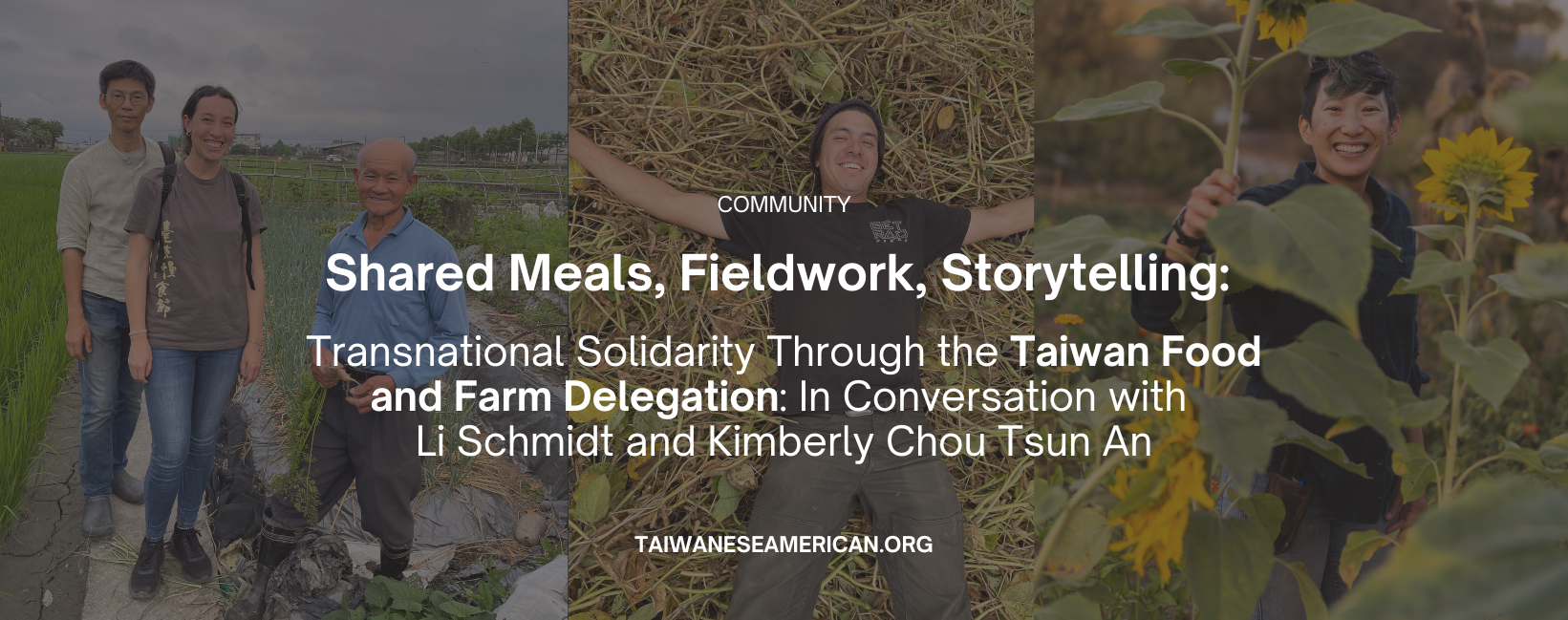
For many in diaspora, food is one of the most tangible threads connecting us to ancestry, memory, and land. Yet the pathways that sustain those connections—seed to harvest, recipe to ritual—are often complicated or even fractured by displacement, colonization, and distance.
It is along these fractured, but fertile, lines that Taiwanese American community organizers Li Schmidt and Kimberly Chou Tsun An have envisioned and built the Taiwan Food and Farm Delegation, a pilot project uniting Asian American farmers and food sovereignty organizers with farmers in Taiwan. Through shared meals, fieldwork, and storytelling, they seek not only to exchange agricultural knowledge but to tend to the deeper connections between land, memory, and community.
Their work reminds us that food sovereignty begins with relationships—across borders, across generations, across movements for justice. By supporting this delegation, we nourish the very connections that sustain our communities: between ancestral practice and present struggle, between the soil beneath our feet and the histories that brought us here.
Thrillingly, the organizers were able to surpass their pilot fundraising goal through a combination of grants, crowd funding and generous support from food justice-focused foundations including The Sye Fund, a family foundation established by Taiwanese Americans. They were also able to raise an additional $1000 through a New York event with Mahjong King and Chino Grande to redistribute to Amis millet farmer and community leader Ke Chun Ji, whose farm was flooded by Typhoon Ragasa. Follow the delegation on Instagram @taiwanfoodandfarmtour and consider contributing to support this program’s continued development. Their 501c3 partners are hosting their fundraiser here; scroll down and select “Taiwan farm delegation” to support.
In this conversation with Editor-in-Chief Leona Chen for TaiwaneseAmerican.org, Li and Kimberly reflect on the paths that brought them together, the parallel challenges shaping small-scale farming in Taiwan and the United States, and the ancestral and political inheritances that continue to guide their work. What follows is a conversation about kinship through cultivation, about the ways land remembers even when we forget, and how tending to soil across oceans can be an act of both return and resistance.
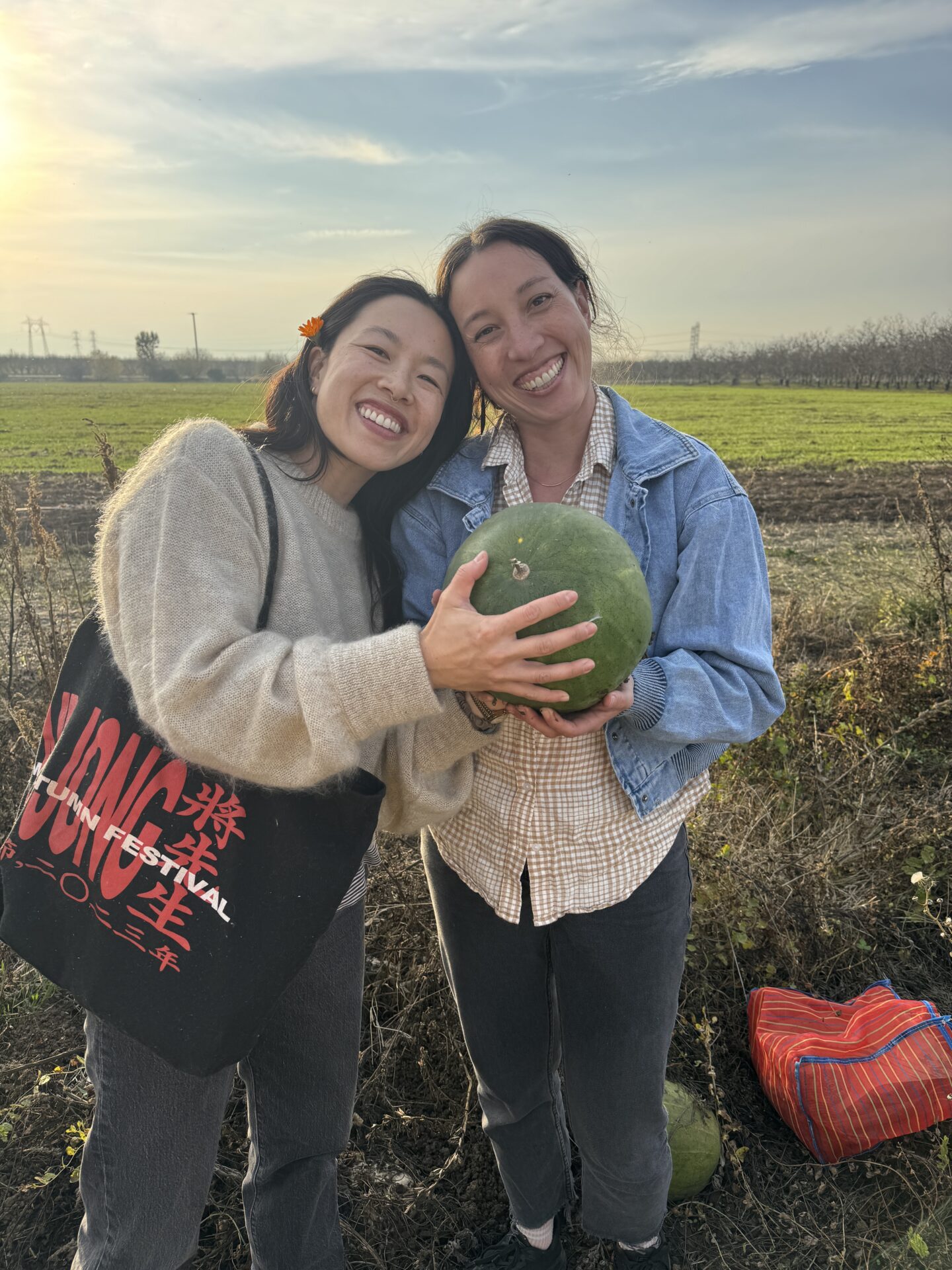
Leona: To begin, can you share the story of how this delegation came together? How do you know each other?
LS: This delegation is a culmination of community building that has taken place over the course of many years. I started my farming business, Cultural Roots Nursery, in 2020 as a way to connect with Taiwanese and broader Asian diaspora community around food–motivated by the fact that so many diaspora communities living in the US experience a feeling of disconnection around traditional foodways and in being able to access traditional foods.
Along with other Asian American-led farming initiatives such as Second Generation Seeds, I have been a part of a communal effort to steward seed varieties, reclaim stories of cultural foods, and to try to fill some of the gap in our communities in being able to access locally grown and ecologically produced heritage foods. As I was becoming a more experienced farmer, I felt a strong yearning to learn more about Taiwanese cultural foods from farmers and foodworkers in Taiwan. Over the last couple of years I started travelling back to Taiwan on my own and was able to start making connections there through Taiwanese food professionals such as Peiru Ko (Founder of the Food Culture Collective).
Last year while in Taiwan I met my co-organizer for this delegation, Kimberly Chou Tsun An, who is a Taiwanese American writer, community organizer, culture worker and landworker based in Brooklyn, NY. We realized that we had very aligned interests in trying to deepen our connection to the Taiwanese food system and in our solidarity work in the US food system. Earlier this year we were able to pursue a funding opportunity with the goal of being able to share some of the formative experiences I’ve had learning about traditional foodways in Taiwan with other Asian American farmers. That was how the Taiwan Food and Farm Delegation was created.
KC: Right after the most recent war on Gaza began, Li posted online about stewarding Palestinian heirloom watermelon seeds in collaboration with a Palestinian American grower friend. As a Taiwanese American who’s been involved in Palestine solidarity work for many years through food justice organizing, I was moved by her demonstration of solidarity and kinship through the medium of farming, and her language contextualizing how our struggles for sovereignty are different yet intertwined.
A few months later, we exchanged contacts through mutual comrades at Choy Commons. (Choy Commons is a collective of Asian American farmers who organize for food sovereignty in the Northeast, run a collective CSA and wholesale program, among other things — several members of whom are now joining us on this delegation.) We met in person while both visiting Taiwan and found opportunities over the past year to keep building with each other and supporting each other’s work. I’d been aware of Li’s dream to pilot an all-landworker delegation to Taiwan; at some point we decided to draft a proposal and shoot our shot.
Leona: You’ve situated this delegation within a broader context of U.S.–Taiwan relations, not in a nation/state sense but through the everyday struggles of land, farming, and food. What shared challenges do small-scale farmers and food workers face on both sides of the Pacific? And what kinds of solidarity do you hope can grow from recognizing and organizing from those parallels?
LS: In talking to Taiwanese farmers over the past couple years about some of the challenges they were facing, I was struck by the similarities to California and US food and farming systems – the rising costs of land, aging farmer populations, a lack of regulatory and fiscal support for regenerative farming, resource competition with big tech and AI, and a rise in diet-related diseases, to name a few. Additionally, I started to learn about the role of US commodity agriculture and its effect on Taiwanese farmers. For example, I learned during my last trip that low cost US-grown soybean exports have made it difficult for Taiwanese soybean farmers to compete, thus greatly reducing the availability of locally produced soybeans in Taiwan. We hope that by identifying these common challenges we will foster solidarity and discover ways to support our efforts in regenerative farming on both sides of the Pacific.
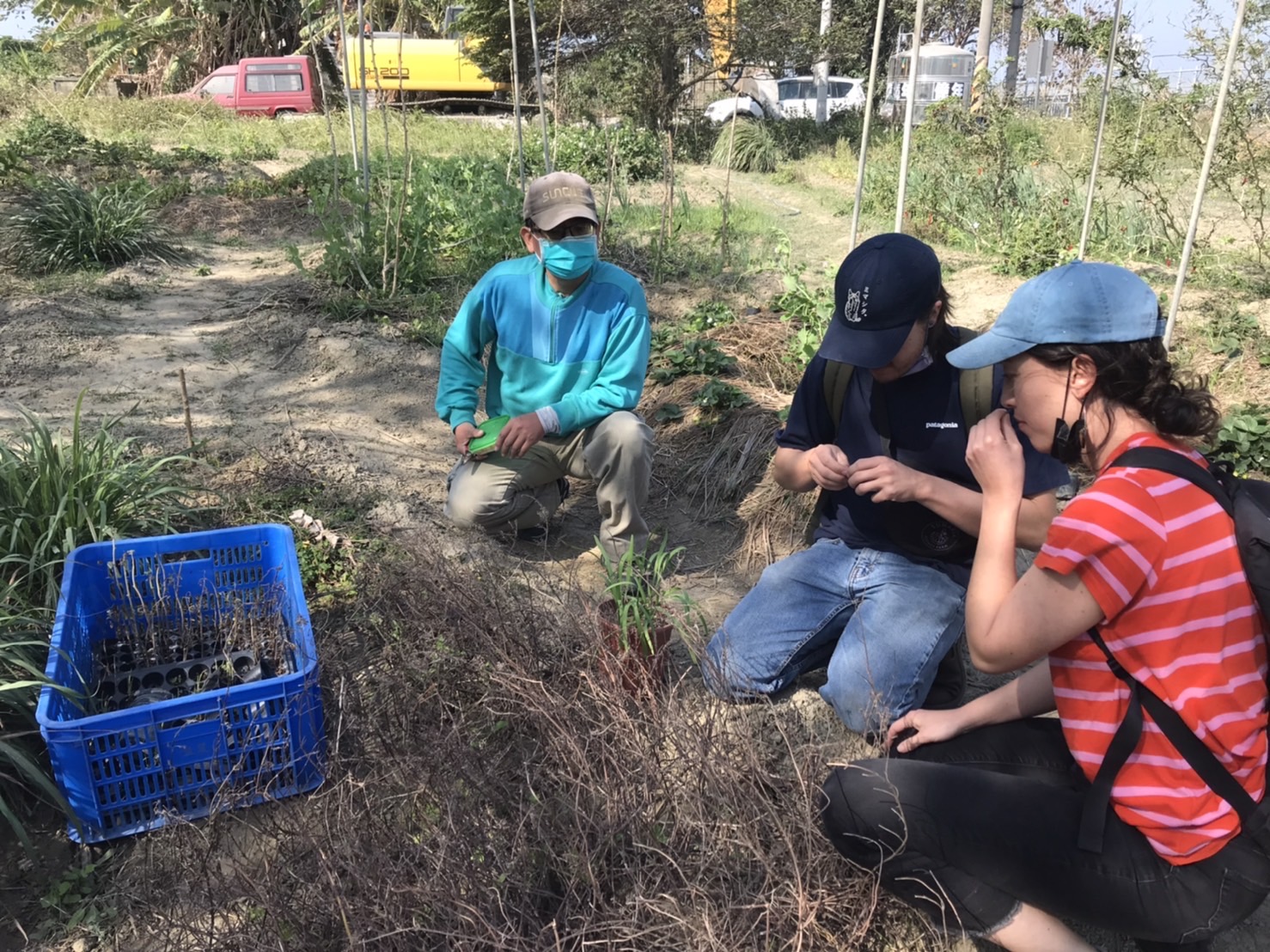
Leona: What farms are you visiting and how did you learn about them? How do you approach building reciprocal relationships with the farms and land workers you’re visiting?
LS: We will be visiting farmers that I’ve either met in person previously or farmers that are connected to one of our community partners in Taiwan. Our goal is to get hands-on experience on farms. We’ll be visiting a beekeeper that stewards native Taiwanese bees, a rice cooperative, and regenerative and Indigenous Taiwanese-led vegetable and fruit farms. We will also be visiting farm to table restaurants and local food businesses that use Taiwanese grown produce. Last year while in Taiwan, I had a conversation with farmers about how to work together to save heritage seeds. In California, where we have a very long growing season that is mostly dry, we have an ideal climate for seed saving, whereas in Taiwan where the climate is subtropical, it can be more challenging to save seeds depending on what region you are in. With certain heritage crops also becoming less profitable to grow in Taiwan, expanding the seed bank to Asian American farmers could be one way to preserve these varieties. This one example of a reciprocal relationship that we hope to build on this trip. Dreaming big in the future, I would love to fundraise for Taiwanese farmers to be able to visit our farms in the US as well.
Leona: Healing, memory, and ancestral knowledge seem central to your delegation’s vision. How do ancestral or earth-based practices—whether Taiwanese, Indigenous, or diasporic—inform your relationship to the land and food?
KC: So many of us living in contemporary times are disconnected from ancestral practices — especially earth-based ones for city folk — for myriad reasons, including but not limited to migration, displacement, assimilation, alienation. It’s a gift to re-connect to traditions or adapt them for our times and in diaspora. I know tapping into that for myself and facilitating it for others is part of my life’s work.
And it’s an ever-giving opportunity to be able to learn and share our different diaspora traditions in community, in a group such as this delegation — which includes land workers from first-generation to fourth-generation Asian Americans, drawing on backgrounds from Taiwan, Hong Kong, throughout China, the Philippines, Japan. For all the reasons I’ve named above, and many others, we’re people of Asian ancestry living and working in different parts of Turtle Island, aka Los Angeles, New York City, upstate New York and Northern California. Reconnecting to ancestral practices, sharing them and making them our own creates the conditions for healing our histories, including heartache and harm between our overlapping histories (i.e. occupation, war) — and for reckoning with the histories of land theft, genocide, enslavement and resource plunder that is woven into the founding of the United States, a reckoning that is necessary homework for all of us who make our lives here.
Viscerally speaking, there is also something deeply spiritual that is touching earth that is meaningful to you — and to experience a comrade or teacher touching earth that is meaningful to them.
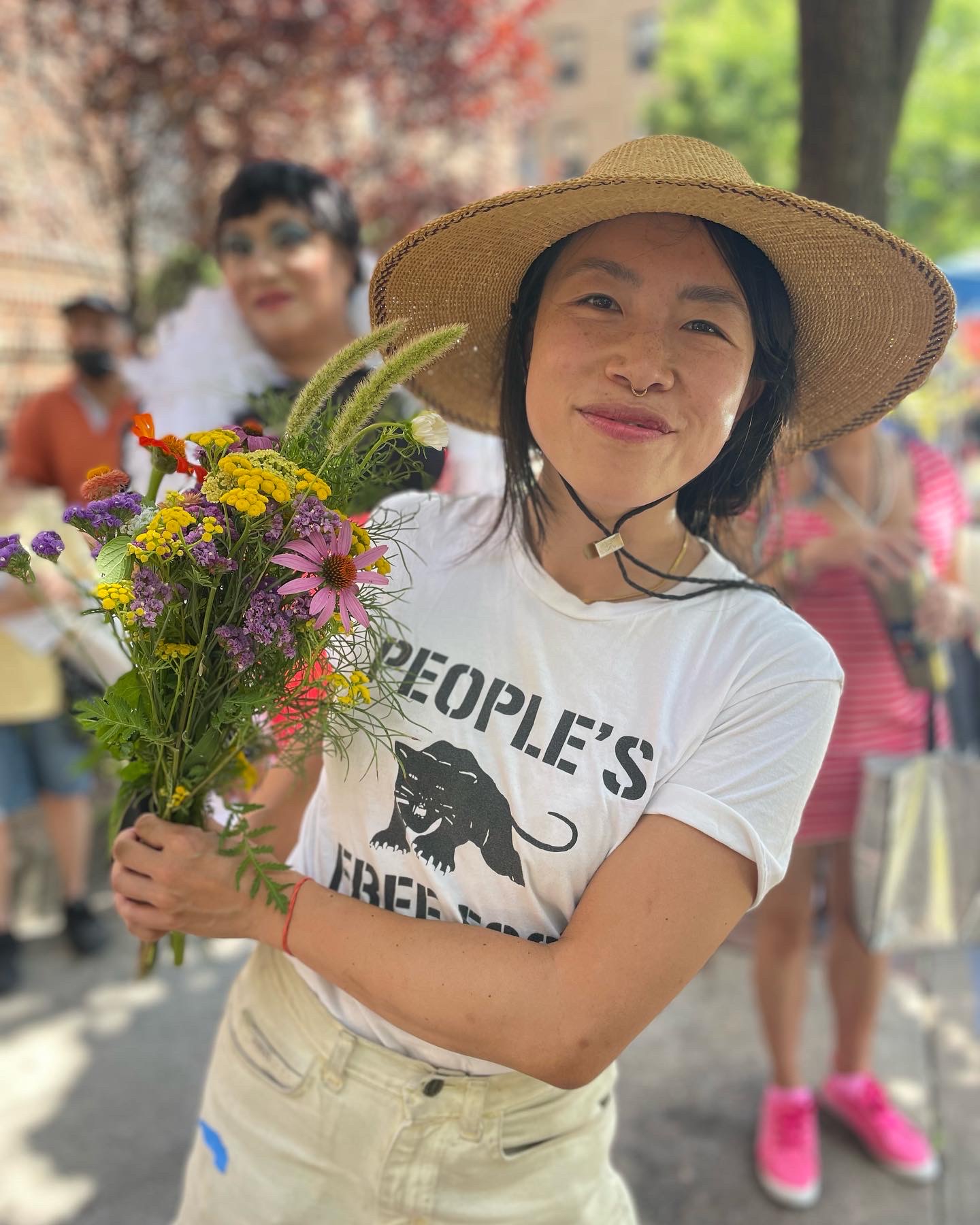
Leona: After returning to your home communities, how do you plan to share what you’ve learned on this journey? What role can diaspora communities play in sustaining and deepening these transnational farmer-to-farmer connections?
KC: We look forward to sharing back concrete skills we’ve learned, critical analyses and cross-movement connections with our communities upon return. We’re asking our network to invite us to speak at study groups, community gatherings and conferences; and interview us for articles and podcasts.
We see sharing our inspirations and motivations in advance of the trip, as well as the lessons learned afterwards — and where we want to continue from there — as opportunities for deeper political education in our extended networks. We believe in political education for folks to have an understanding and analysis of why we are in the conditions we find ourselves: farmers struggling with climate catastrophe on multiple levels, challenges with land access, the years of machinations and escalation that have brought us to the current triangulation of US-Taiwan-China relations, and so much more. Harnessing this knowledge allows us to connect big picture topics to everyday concerns, and to understand how we can shift narrative and culture even with seemingly small steps, starting with ourselves and our communities.
There’s also nothing like a taste of home as a driving force, even home a few degrees removed. We hope our people in diaspora continue to learn about the heirloom Taiwanese and other Asian vegetables our farmers grow, and then join one of our farmers’ CSAs, request them at farmers markets, or order plant starts from Li’s nursery. There’s impact in transnational economies too: We see the power of education and storytelling in service of real economic benefit with examples like our friend Lisa Cheng Smith’s Yunhai Shop, which imports and distributes products from small producers and farmers throughout Taiwan.
Leona: What role can diaspora communities play in sustaining transnational farmer-to-farmer relationships?
LS: Diaspora communities that care about farmers, sustainable farming practices, and heritage foods can support this pilot trip through donating and through sharing our stories. As farmers, we have self-funded a lot of the work we do to learn about cultural foodways and to do our best to take care of the environment and people while doing it– making trips to our ancestral homelands or to be stewards of the Indigenous lands that we farm on in the US, and to be in solidarity with other BIPOC farmers. Purchasing food and products from our businesses also goes a long way in supporting our farming. On the Taiwan side, we hope that this trip will invite other people in diaspora to also seek out buying products from regenerative farmers while visiting Taiwan. What I think it really comes down to is that no matter where you are, try to get to know your farmer!
Leona: How can folks directly support you? Can you share more about your funding priorities?
KC: We’ve met our initial fundraising goal of $15K to cover our delegates out-of-pocket travel expenses — all of whom are taking precious time off during the growing season to go on this trip — and further funds will support our ability to to amply pay farmer honoraria and participate in Taiwan’s hospitality culture (host gifts, shared meals). It’s important for us to be able to cover and compensate everyone who is contributing to this delegation, recognizing the labor, knowledge and time they’re sharing with us. You can also follow our trip through IG @taiwanfoodandfarmtour, which has launched as of the Mid-Autumn festival.
Follow their journey on Instagram @taiwanfoodandfarmtour and consider contributing to their fundraiser to support farmer honoraria, and shared meals. Their 501c3 partners are hosting their fundraiser here; scroll down and select “Taiwan farm delegation” to support.



Leave a Reply