

We are so pleased to present the following conversation between two Taiwanese American authors we admire, Kristi Hong (“The Teacher’s Match”) and Michelle Young, on Young’s newest book, The Art Spy. A riveting and stylish saga set in Paris during World War II, The Art Spy uncovers how an unlikely heroine infiltrated the Nazi leadership to save the world’s most treasured masterpieces.
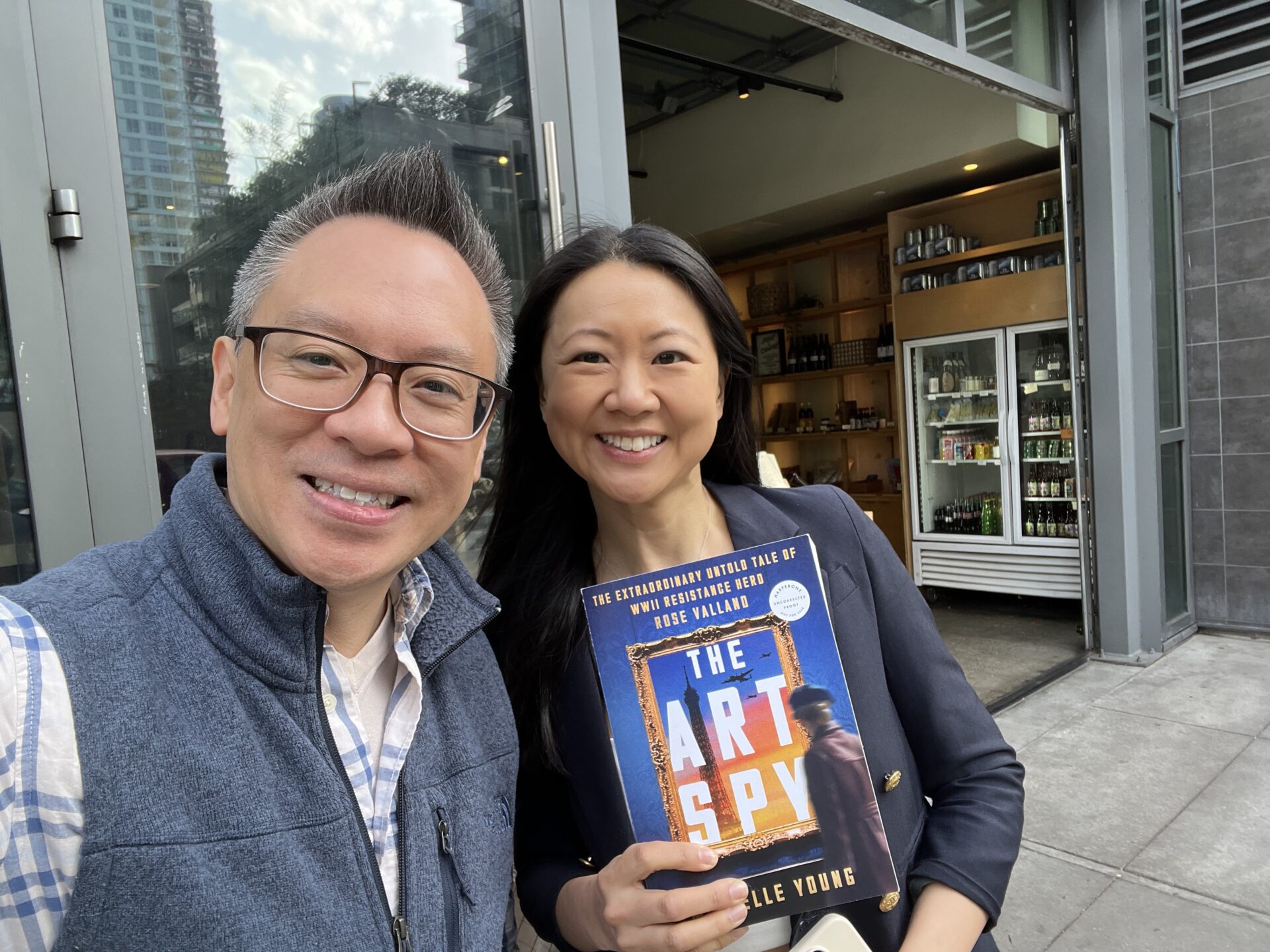
K: First off, huge congratulations on the book, and thank you so much for doing this interview! There is so much buzz about The Art Spy already, so I’m honored to be able to interview you. Can you start off by telling us about yourself, and your connection to the Taiwanese American community?
M: Thank you! It’s been an exciting lead up to the release. My parents are Taiwanese immigrants who came to the United States in the mid-1970s for graduate school, first to Boston, then Queens, and finally to Long Island where I was born. Since as long as I can remember, we spent our social time at Taiwanese church and at innumerable Tong Hsiang Hui 台灣同鄉會, those Taiwanese banquet gatherings. I took my first trip to Taiwan at age four and it left an indelible memory on me. Later in college, I was involved in the Taiwanese American student group at Harvard, spent a summer studying Mandarin Chinese in Taipei, and helped plan the ITASA conference. After college, I was invited to speak at ITASA when it was in New York City.
K: What is The Art Spy about, and how did you come to tell this story?
M: The Art Spy is the true story of WWII Resistance hero Rose Valland, a French art historian, who spied right under the noses of some of the most powerful Nazis while working in a museum right next to the Louvre and helped take down Hermann Göring’s art looting ring. If you’ve heard of the Monuments Men, she was a Monuments Woman and the hero who gathered all the intelligence that enabled the Monuments Men to locate the hundreds of thousands of looted artworks stashed away in Germany and Austria. I tell Rose’s incredibly brave and exciting wartime story, from 1939 to 1944.
A secondary storyline is about a Free French soldier, Alexandre Rosenberg, who fought for Charles de Gaulle. His father was the exclusive art dealer to Picasso, Matisse, Braque, and Léger and a very influential person in the art world. I won’t give too much away except to say that Rose and Alexandre are tied in an incredible way.
I first came across Rose in an art book about Hermann Göring’s art dealer in Paris, called Göring’s Man in Paris. Since I read almost exclusively female spy non-fiction books (no exaggeration), I was amazed that I had not heard of her. And more importantly, I was so inspired by her bravery. It felt like fate to be the writer entrusted with telling her story—her true, exciting story.
K: Something that amazes me about the book, right from the opening chapter, is the sheer amount of information you had to gather about Rose Valland. Talk about the research you had to do. Was it difficult to obtain? How persistent did you have to be?
M: The Art Spy took me four years to create. The research was immense–I went to archives and interviewed people in France, Germany, United Kingdom, the United States and even some more obscure places like Latvia! The art world is international, and even during the 1930s and ‘40s, curators were traveling all over and working with counterparts in so many different countries. Rose Valland, as a subject, came with an additional challenge. She almost never spoke of her emotions or her thoughts, like a good spy, despite leaving behind hundreds and thousands of documents. She was also lesbian, which meant an additional layer of hiding her true self. To make her come alive, I had to doggedly track down personal letters and decipher the scribbled notes and drafts she left behind for clues.
Then I had to organize the documents, because archives are not always perfectly organized by any means. As I wrote the chapters, I would figure out what additional research I needed and sometimes the quests for what became a single adjective, a single line, or a single chapter in the book, would take months and I would work on everything concurrently. The last task was to translate all the research into compelling prose—this is a book written to read like a novel, but everything is true. I had to use a different part of the brain to do that.
My Taiwanese upbringing was actually key to all of this work. Like many others, I was trained as a classical musician, first piano at age 4, and cello at age 7, and I eventually went to Juilliard for cello. My mom had heard that Harvard needed cellists, so she picked that instrument! And of course, my schoolwork could not suffer with all the music and other extracurriculars that were also expected to be done at national award-winning levels! I eventually fulfilled my Asian destiny and got into Harvard (phew). Joking aside, all of this dogged persistence in everything I put my mind to—because as we all know, what was the alternative?—gave me the mental fortitude and tenacity to keep going no matter what to find the answers I needed. Most times, I felt like a detective.
K: At least for me, the topic of art can be rather intimidating, but I found the story of The Art Spy fascinating, and the book really reads like fiction. How did you approach structure and plotting? Did everything just fall into place naturally?
M: My answer to this question usually freaks writers out! I wrote this book with no outline. I thought of it as a reader would, feeling where the story should go next rather than planning it out in advance. This type of working comes from my architectural design background, where I learned to embrace the idea of iteration. You just have to start working, try things, allow ideas to form organically, and also allow ideas to fail. I began working this way in my mid-twenties when I realized I needed to embrace a less planned out life—the exact opposite of everything that had brought me success until then didn’t exactly work out as well in real life.
That being said, you can’t write like this and have no organizing principle. I knew that I wanted to tell Rose Valland’s wartime story, so roughly 1939 to 1944, and that I wanted to tell two storylines, Rose’s and that of a Free French soldier named Alexandre Rosenberg, whose story intersects in an incredible way with Rose’s. But I honestly did not know if I would have enough information for either story when I started the project. But it all worked out.
K: As a romance author, I’m always intrigued with the love stories that emerge from unexpected places. Rose Valland and Joyce Heer’s relationship definitely seemed one for the ages; was there anything surprising you learned about their relationship during your research?
M: I unearthed so much new information about Joyce, who was a virtual ghost. She wasn’t a public figure, and given attitudes towards homosexuality in France, it wasn’t surprising that Rose kept Joyce under wraps their whole lives. I don’t believe she introduced her even to her own family, or at best, just her very closest cousin Marguerite. But I learned just how educated and brilliant Joyce was—in fact, she successfully received a PhD in Greek literature—and did it on her deathbed from cancer! The other surprising thing is that even after Joyce died in the late 1970s, Rose still kept their relationship secret when she published Joyce’s PhD as a book posthumously. Rose is only referred to as a “close friend.”
K: You mention in the Author’s Notes that you felt a kinship with Rose, specifically mentioning identifying with “her fight to be acknowledged in a man’s world.” Can you talk more about challenges you’ve faced in your career so far—as a woman, and also as a POC/Asian-American? What advice would you give, specifically to an aspiring Taiwanese American journalist or art historian?
M: First, I need to give a shoutout here to Jeff Yang, who founded A. Magazine. He’s my cousin! And he dutifully agreed to let me intern there when my father asked, hoping to keep me out of trouble after my senior year in high school! I was rebelling in the Asian American way, which is not really much of a rebellion, but my parents were horrified. So that’s how my journalism career started.
After college, I went to work in the fashion world as a merchandiser. Almost every step of that career, I felt the Asian female glass ceiling very palpably. If you spoke out too much, you were told not to. You would be doing comparable work as others, getting the same reviews, sometimes with more responsibility as others, but be promoted slower. I quit one job because my boss, a Vice President, told me to lie to the CEO about how much we bought of a product. I refused to do it, because that information would easily be verified in documents on our server. But why did she ask me to do it, I do wonder? Because she thought I would comply? Even if it wasn’t overtly applied, the Asian stereotype was hard to break.
That’s one of the reasons I started my own company—and my personality is much suited to entrepreneurism as well. When I work for other people, I worry about pleasing them and following rules, and become much less creative. With my own work and business, I’m a lot more daring.
But still, there have been times where you notice that men treat you a certain way—disdainfully—because you are female (and maybe also Asian). One time, this guy copied my husband on a business email but did not address him—and why? Because he thought my husband was my keeper? I’ve really encountered the whole gamut of experiences. Even with this book, I’ve had a well-known male writer accuse me of not consulting him on my research. A woman would not even dare to write such an unhinged, desperate email. Also, I had multiple compelling reasons not to, not that they should matter at all.
K: This story seems like it would make the perfect film—any dream actresses you’d love to play Rose and Joyce?
M: For Rose, Audrey Tatou of Amelie fame, Marion Cotillard, or even Natalie Portman who has been living in France for many years now. For Joyce, you’re the first person to ask that! She looks like Saoirse Ronan!
K: What’s next for you? You are also the author of the Secret Brooklyn and New York series—so maybe a Paris or Taipei edition someday?
M: I’m going to keep working on investigative-like, narrative non-fiction books—whether historical or contemporary. I can’t reveal the next project yet, but I will take a break from WWII and likely return to it after. I also have a novel project that I write on my Apple notes app every time I go to Taiwan. It took me more than forty years to get here, but I think I would like to spend some time living in Taiwan at some point. I went again at the end of April just before my book launch and am taking one of my daughters!
K: Along the same theme, any must-visit recommendations for Paris?
M: There are so many! But if you want to see Rose Valland’s world, you can visit the Jeu de Paume museum, where she worked, which is in the Tuileries Garden next to the Louvre (also a must-visit). The plaza next to the museum is now named in her honor. Her apartment building on Rue Navarre in the Latin Quarter is still standing and there is a plaque dedicated to her. And Joyce worked across the Place de la Concorde at the US Embassy which is a beautiful building. And get hot chocolate in Paris—American hot chocolate is just not real hot chocolate, in my opinion.
K: How can the Taiwanese-American community best support you? And do you have any last thoughts before we sign off?
M: Please invite me to speak! Order the book and leave a 5-star Goodreads rating! Not surprisingly, my parents have activated their Taiwanese community who have already pre-ordered many books! I’ll also be giving a Zoom talk with Jeff Yang for Harvard Asian American Alumni Alliance which is open to the public with registration.
I also believe I may be one of the few Taiwanese or Asians to write about the European theater of WWII. Ethnicity shouldn’t matter—we have the same right as anyone else to write about what we are experts in and I would love to see more Asian Americans writing about all subjects and working in careers that are less expected.
Michelle Young is an award-winning journalist, author, and professor whose writing and photography has appeared in The Wall Street Journal, The Guardian, Hyperallergic, The Forward, and Narratively. She is a graduate of Harvard College in the History of Art and Architecture and holds a master’s degree from Columbia University’s Graduate School of Architecture, Planning and Preservation, where she is a Professor of Architecture. She is the founder of the publication Untapped New York. She divides her time between New York City, Paris, and the Berkshires, Massachusetts.
Social links:
Instagram @michelleyoungwriter
Threads @michelleyoungwriter,
Bluesky @michelleyoung.bsky.social
Kristi Hong was born to immigrants from Taiwan and grew up in Michigan, and while she’s lived in many different places, she’s a Midwestern girl at heart. After a career on Wall Street, Kristi fulfilled her middle school dreams by becoming a published author, with a goal of writing books featuring diverse characters, particularly Asian-Americans. Kristi worked at an ice cream store and a florist as a teenager and has loved all things dessert- and floral-related ever since. When not writing, Kristi can be found reading a book, taking a long afternoon nap, or munching on a pan-fried dumpling.
Related posts:
 On Identity, Writing, and Preserving Heritage: Erica Lee Schlaikjer (“Wild Greens, Beautiful Girl”) in conversation with Crystal Z. Lee
  David Li-Wei Chen Introduces his Handbook of Romanized Taiwanese & Hokkien
  Your New Classic Slow Jam: Music by Jerry Jean
  Hello from Taiwan: Q&A with Filmmaker Tiffany Frances
Leave a Reply