“To write is to share; to share is to be seen”: Jane Kuo, in conversation with Rebecca Yang

As a daughter of Taiwanese immigrants growing up in suburban Los Angeles County, I didn't expect to find any literature that reflected my niche in life. That is, until I found Anna Zhang in Jane Kuo's books In the Beautiful Country and Land of Broken Promises. Anna is a middle schooler who immigrates to the United States (which she calls "The Beautiful Country") for the prospect of a better life. Instead, what she finds is a vastly different community---one with unfamiliar faces, discrimination,…

Keng-lâm Su-iⁿ: Writing A New Chapter for Tâi-gí

Meet the educator-activists turning the tide on Mandarin hegemony to nurture a new generation of Taiwanese speakers and storytellers. [caption id="" align="alignnone" width="2048"] From L to R: Hô Phè-chin, Lûi Bêng-hàn, Tīⁿ Têng-têng, Ong Úi-pek[/caption] Founded in 2024, Keng-lâm Su-iⁿ (The Mosei Academy of Taiwanese Language and Literacy) has quickly become a dynamic and influential forces in Tâi-gí (Taiwanese) language revival. Rooted in a pragmatic praxis, the collective’s…

Light as Insistent: Alvin Lu (“Daydreamers”) in conversation with Shawna Yang Ryan

Alvin Lu’s second novel, Daydreamers, was released on July 15th. It’s a dreamy, unsettling book that radiates intelligence and beauty. Difficult to summarize, I will rely on this line from the publisher’s description, though even that cannot capture the many layers of this book: “Cycling between San Francisco, Los Angeles, China, and Taiwan, the novel unfolds across generations of Chinese immigrants and diaspora artists, linked by tenuous friendships, publishing feuds, and the obscure…

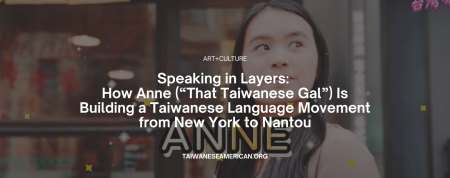
Speaking in Layers: How Anne Is Building a Taiwanese Language Movement from New York to Nantou

Editor’s Note: In this article, we use the terms “Taigi” and “Taiwanese” interchangeably to refer specifically to Taiwanese Hokkien, also known as Taigi or Tâi-gí (台語). While commonly spoken in many Taiwanese households and often associated with Taiwanese cultural identity, it is important to recognize that Taigi is not currently the official language of Taiwan, nor is it the sole language spoken by those who identify as Taiwanese. Taiwan is home to a rich diversity of languages,…

Where we come from, who we stand with: A Conversation with Professor Hsin-I Cheng (Part 2/2)

(Link to Part 1: Citizenship, Belonging, and the Emotional Legacies of Immigration) Part 2: The Model Minority Myth and the Politics of Proximity Editor's Introduction: In Part 1, we explored how first-generation Taiwanese immigrants often understand citizenship as something earned through discipline and compliance— a framework shaped by colonial history, martial law, and immigration regimes. But these beliefs intersect with powerful narratives like the model minority myth, which casts Asian…

“Like a Box of Chocolates”: Formosa Chocolates’ Kimberly Yang Talks About a Life That Led Her to Chocolate Making

If life were like a box of chocolates, one could only hope it would be a box of Formosa Chocolates; each, a veritable jewel box of brightly colored chocolate bon bons with flavors like coconut caramel, passionfruit, or a surprising membrillo yogurt. Its founder Kimberly Yang is a psychiatrist-turned-chocolatier and her boxes of bon bons are a diverse and adventurous assortment. Today, she produces chocolates out of her commissary kitchen in San Rafael, California. The variety evolves and changes,…

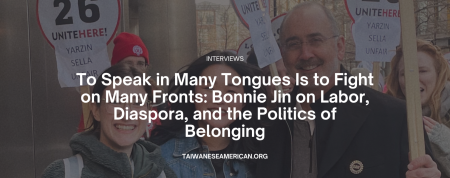
To Speak in Many Tongues Is to Fight on Many Fronts: Bonnie Jin on Labor, Diaspora, and the Politics of Belonging

Taiwanese American Bonnie Jin is one of the most brilliant voices of our generation, lucidly alchemizing identity into strategy as a multilingual union organizer and storyteller. In a conversation for TaiwaneseAmerican.org, we talk about how diasporic experiences can inform a labor movement rooted in empathy and collective care, and the kind of Taiwanese American stories we want to tell – and for whom.  When asked about her Taiwanese American lineage, Bonnie begins with an ancestral origin…

Walking through the Forest with Artist Szu-Chieh Yun: A Conversation Between Sisters

On Friday, May 16th, the Museum of Fine Arts, Boston unveiled Into the Forest, a large-scale mural installation created by Taiwanese American Fine Artist and Arts Educator Szu-Chieh Yun (雲思婕), in collaboration with nearly 200 local youth. The mural — a vibrant landscape alive with curiosity, chaos, and the texture of rushing water and flowing trees — was the culmination of the Museum’s Community Arts Initiative, a program that invites young people to co-create with a professional artist…

Rose Valland, the Woman Who Outsmarted the Nazis: Michelle Young (“The Art Spy”) in conversation with Kristi Hong

We are so pleased to present the following conversation between two Taiwanese American authors we admire, Kristi Hong ("The Teacher's Match") and Michelle Young, on Young's newest book, The Art Spy. A riveting and stylish saga set in Paris during World War II, The Art Spy uncovers how an unlikely heroine infiltrated the Nazi leadership to save the world's most treasured masterpieces. [caption id="" align="alignnone" width="1920"] Ho Chie Tsai (TaiwaneseAmerican.org founder) with Michelle Young,…

Lunchbox: Anne Hu Serves a Taste of Taiwanese America in 90s-Era Cleveland

Nearly four years ago, filmmaker Anne Hu spoke with Grace Hwang Lynch for TaiwaneseAmerican.org as she was crowdfunding to make Lunchbox, a dramatic, three-part coming-of-age short drama about regret, healing, and honoring the people we love. In the film, when a Taiwanese American woman (Shirley), prepares lunches from her childhood, she struggles to forgive herself for pushing away her immigrant mother.  Hu had written Lunchbox in 2017, when a Facebook video appeared on her feed, capturing…